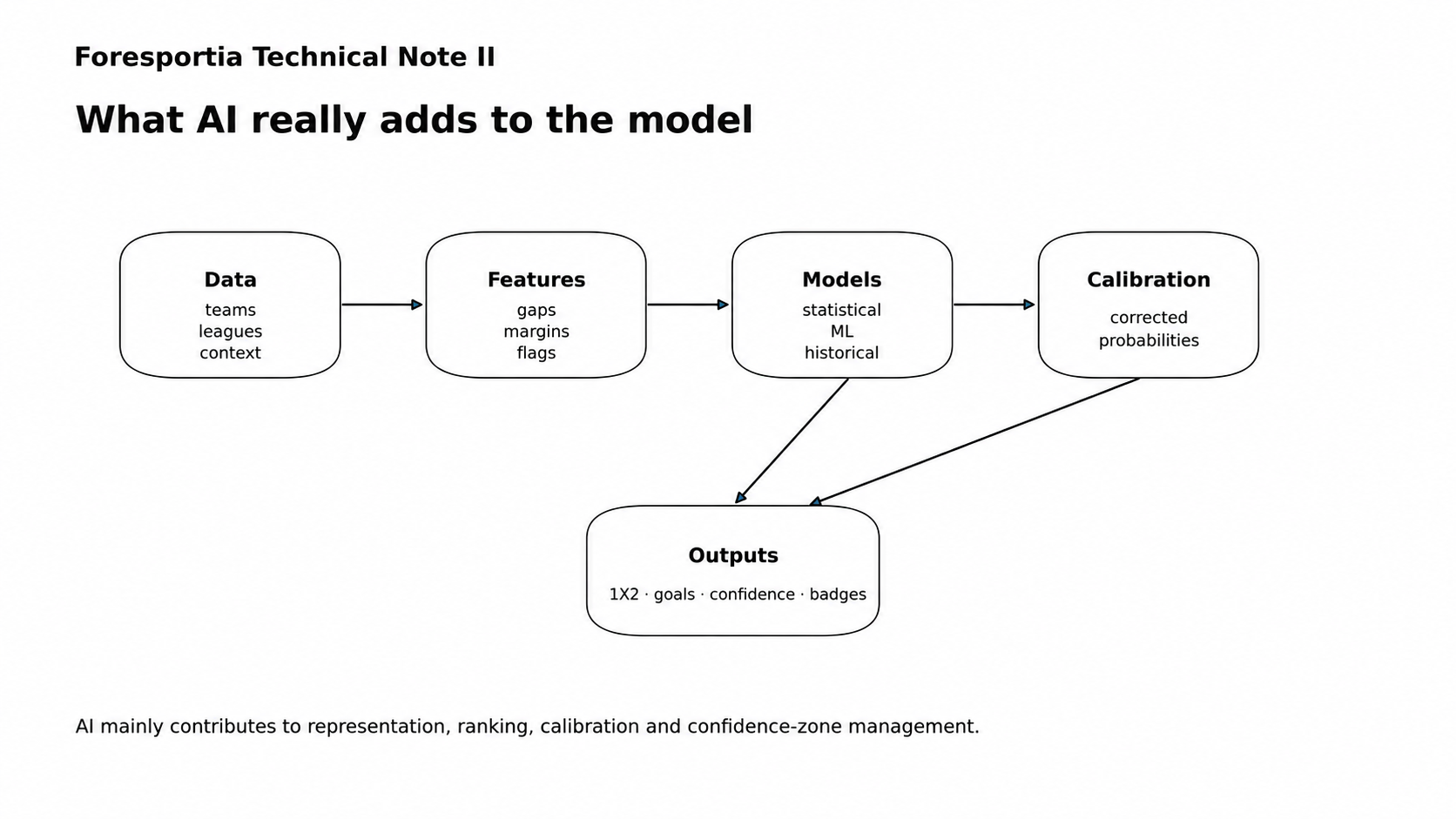
Core idea
AI does not turn football into a deterministic system. Its value is more specific: it helps represent matches, combine signals, detect non-linear interactions, calibrate probabilities and avoid overconfident readings.
From probabilities to representation
Technical Note I showed that a football match should be modeled as a probability distribution rather than a certainty. This second note asks a different question: if uncertainty remains unavoidable, what does artificial intelligence actually add?
The answer is not “magic”. AI is useful because football prediction is not only about collecting data; it is about building a representation of a match that makes weak, noisy and contextual signals comparable.
This note in the Foresportia Technical Notes series
1. AI is not a shortcut around uncertainty
In football prediction, “AI” is often used as a vague promise. That is not how Foresportia uses it. AI cannot know a hidden injury, guarantee that a favorite will convert chances, or predict an early red card. The uncertainty remains.
What AI can do is help decide how to use available information. It can learn that an ELO gap does not have the same meaning across leagues, that a home favorite and an away favorite should not be treated identically, and that some contextual situations make a probability more fragile than it looks.
AI does not remove randomness. It improves representation, ranking, calibration and signal stability. This distinction is essential: the model remains probabilistic, not deterministic.
2. Foresportia uses a hybrid architecture
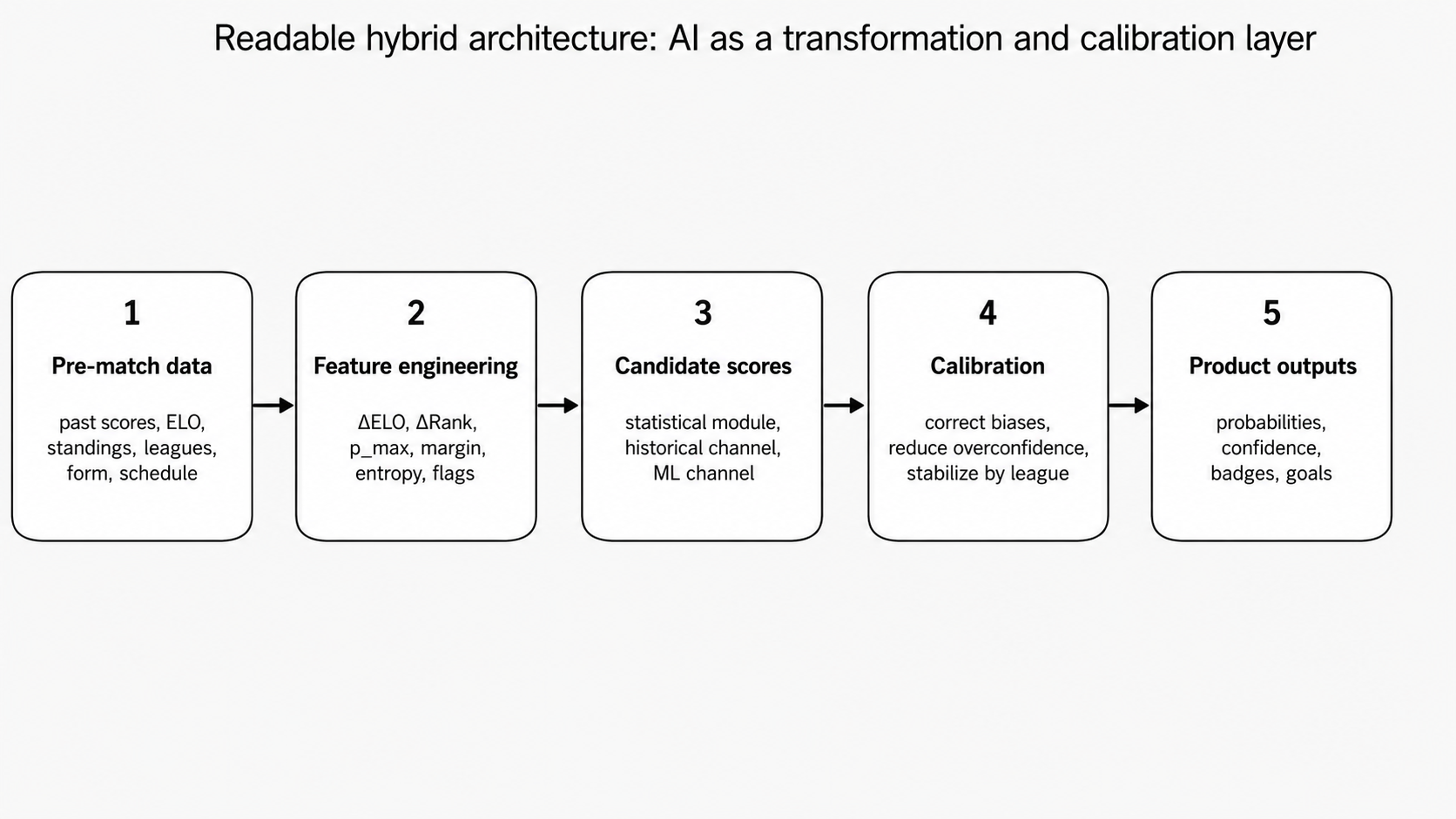
A purely statistical model is interpretable and robust, but can be too rigid. A pure machine learning model can capture interactions, but may overfit noisy football events. Foresportia therefore uses a hybrid architecture.
where:
- Xstat: team strength, ELO, rankings, goal trends, form and home/away behavior.
- Xcontext: season phase, fixture congestion, fatigue, rotation risk, European proximity and stakes.
- Xhistorical: empirical performance by league, probability range, confidence segment and market.
- fθ: the modeling function combining statistical rules, calibration and machine learning components.
3. Feature engineering: turning a match into structured information
A match is not directly a vector. It must be represented through measurable signals. Feature engineering is the step that transforms raw football information into variables that a model can use.
These features are simple examples, but their interpretation is not simple. A rank difference may be meaningful in a stable domestic league, less meaningful early in a season, and misleading in a cup or in a league with strong schedule imbalance.
Foresportia therefore does not only feed raw signals into a model. It contextualizes them: home vs away, league behavior, season progression, recent form, historical reliability and match environment.
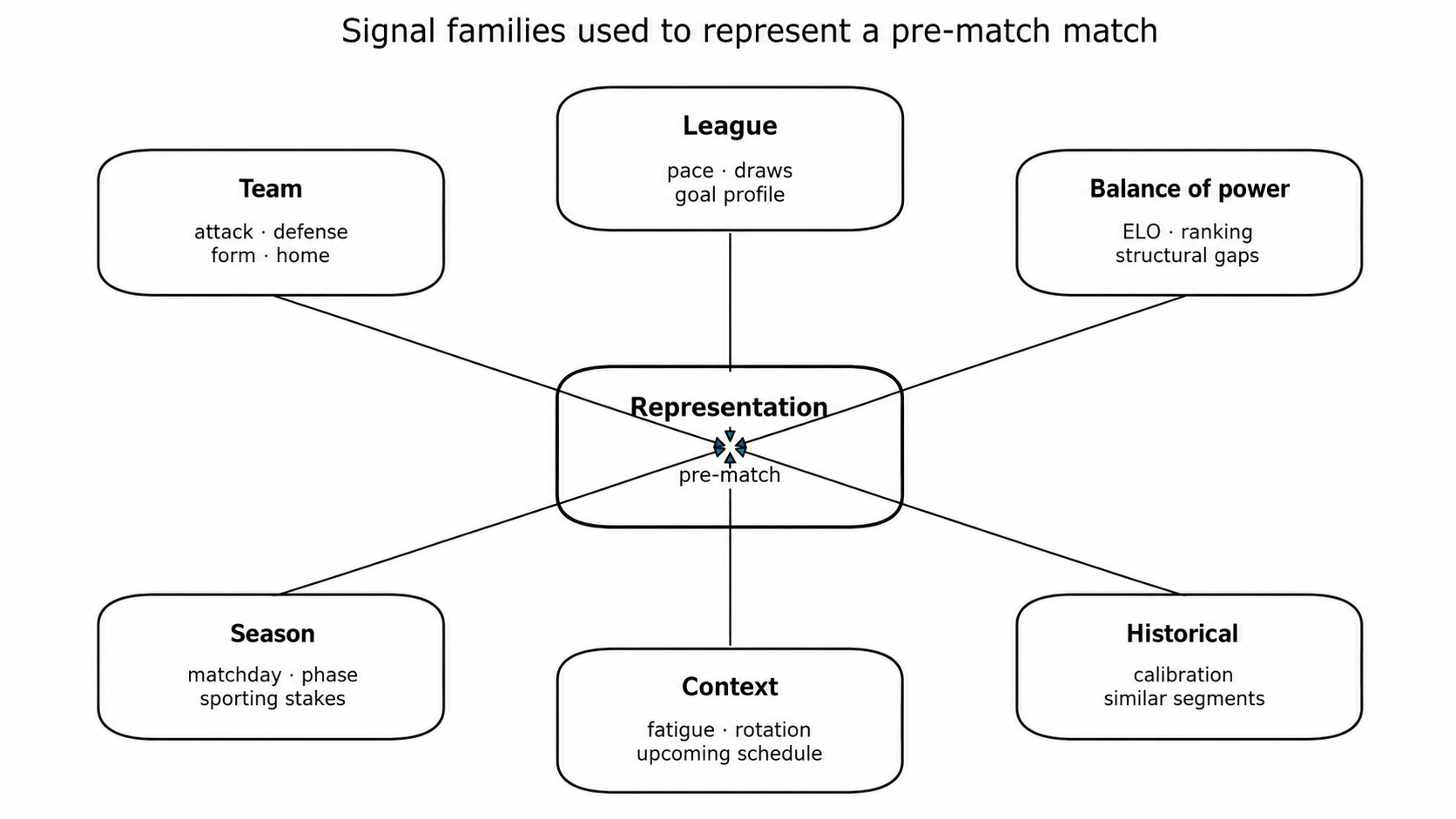
4. The main families of signals
The public model can be understood through several families of signals. None of them is sufficient alone; the value comes from their combination.
| Signal family | What it captures | Why it matters |
|---|---|---|
| Team strength | ELO, ranking, home/away strength, goal balance. | Defines the structural power relationship before context. |
| Current dynamics | Form, recent results, scoring trend and defensive trend. | Helps distinguish long-term strength from recent trajectory. |
| League behavior | Historical predictability, pace, draw frequency and variance. | The same probability does not mean the same thing in every league. |
| Season phase | Early season, regular phase, late season and schedule position. | Changes how rankings, motivation and uncertainty should be read. |
| Contextual flags | Fixture congestion, fatigue, rotation risk, European proximity, stakes. | Prevents the model from treating fragile favorites as normal favorites. |
| Historical calibration | Observed success rates by probability range, league and confidence segment. | Turns a raw score into a probability that can be checked empirically. |
5. AI is useful because interactions are non-linear
A key contribution of machine learning is the ability to represent interactions. In football, the same numerical signal can have different meaning depending on the environment.
This simplified expression shows the logic: the effect of an ELO gap can depend on home advantage. In real match modeling, similar interactions may involve league, ranking conflict, fatigue, season phase or draw profile.
Machine learning helps the model avoid one-size-fits-all rules. A strong home favorite in a stable league is not equivalent to a strong away favorite in a volatile league after a European fixture.
6. Contextual AI: when the same probability is not equally reliable
Two matches can both show a 65% favorite, while one is far more fragile than the other. This is why Foresportia uses contextual signals to adjust confidence.
This kind of score does not replace the main probability. It helps determine whether that probability should be trusted, downgraded, or read with caution.
This is where AI becomes useful at a product level: it can learn when a combination of contextual signals has historically made a model too confident. A single flag may be weak; a combination of fatigue, European proximity, late-season stakes and a strong favorite may become meaningful.
7. From raw model scores to calibrated probabilities
A model can produce a raw score, but users need probabilities. Calibration transforms scores into values that can be interpreted as frequencies.
For multiple outcomes, a softmax-like transformation may be used:
The temperature T controls confidence. A model that is too sharp may look impressive on individual matches,
but will perform poorly in log loss and calibration. A useful model must remain honest about uncertainty.
8. AI also helps detect overconfidence
A common failure mode in football prediction is overconfidence. The model finds a favorite, assigns a probability that looks strong, and ignores that the match is actually fragile.
Foresportia uses several mechanisms to limit this: probability calibration, entropy, margin, contextual flags and historical performance by segment. The goal is not to make the model timid; it is to make it more honest.
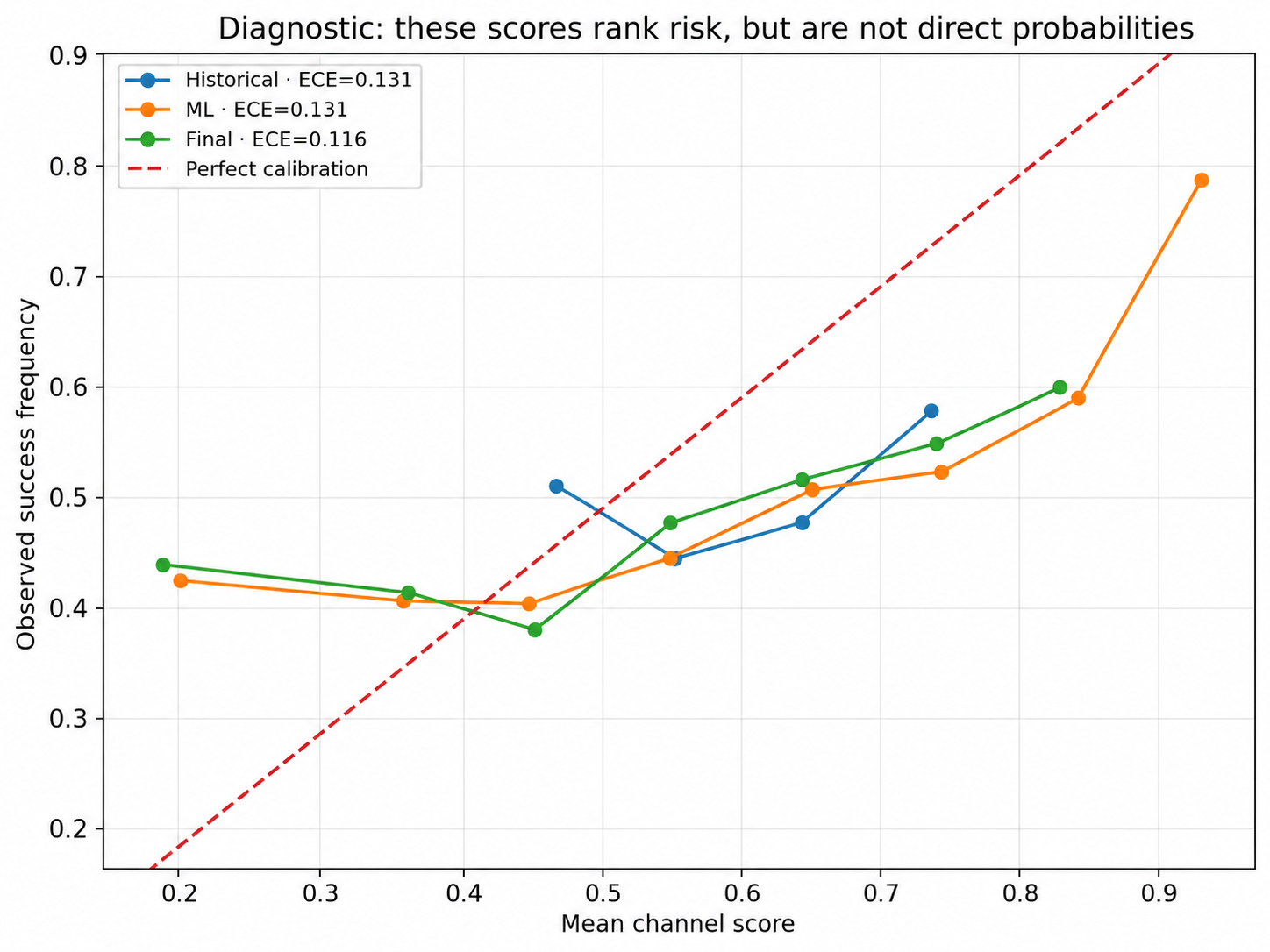
A model can be directionally useful and still poorly calibrated. This is why Foresportia separates probability, confidence, stability badges and empirical validation.
9. Empirical reading: signal quality matters more than global noise
The global model is evaluated on thousands of matches, but global metrics include both strong and weak signals. The important product question is whether the model can identify where its own signal is more reliable.
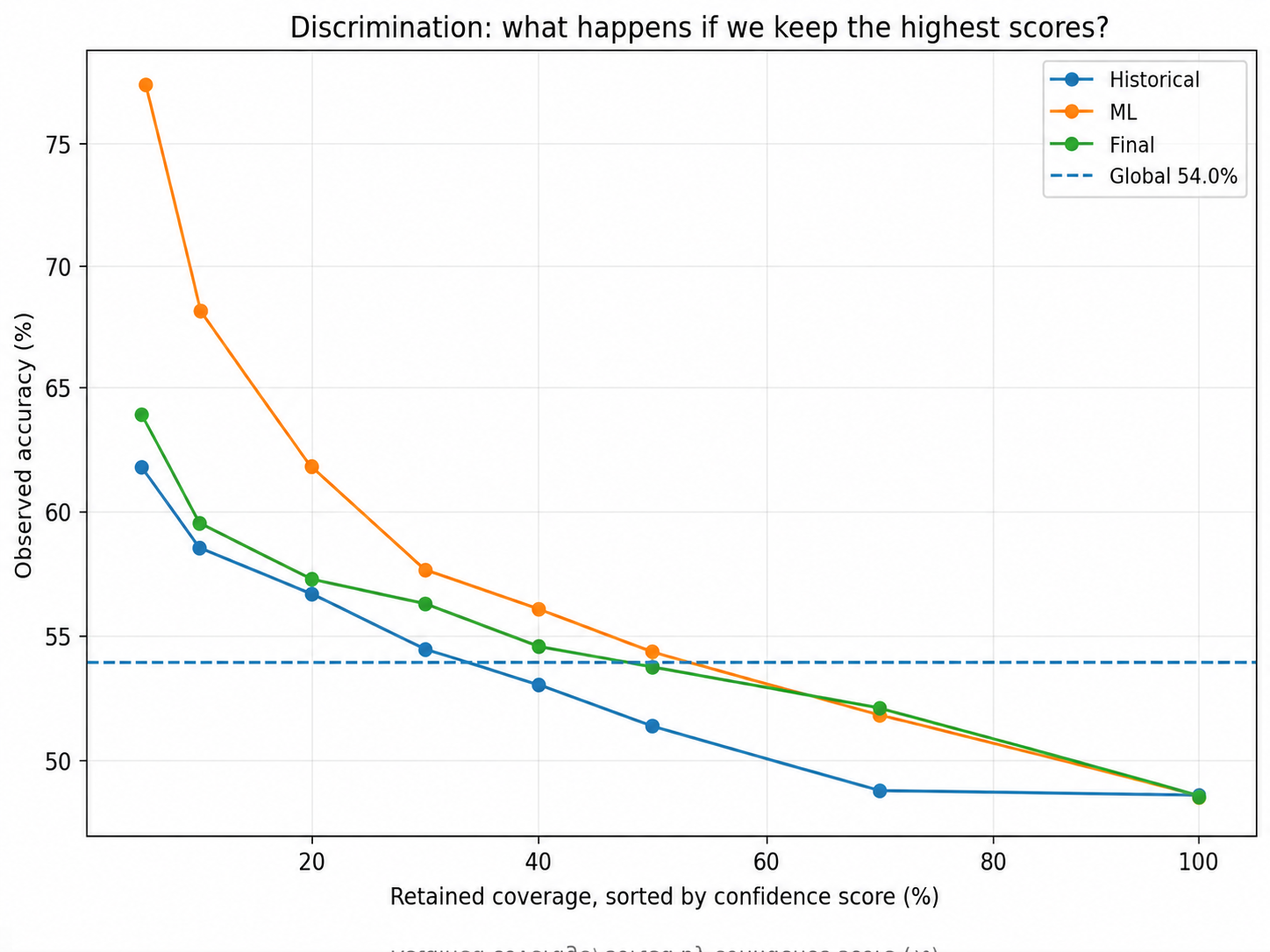
This is why the following note focuses on entropy, margin and confidence. AI helps construct the representation, but the product value appears when that representation can be turned into an interpretable stability signal.
10. What AI cannot do
AI cannot predict every random event. It cannot know a hidden injury that is not in the data, guarantee that a striker converts a chance, or fully anticipate tactical surprises. A red card after five minutes can destroy a perfectly reasonable pre-match distribution.
This is not a weakness specific to Foresportia. It is a property of the problem. Football prediction must remain probabilistic, and every probability must be evaluated as a long-term statistical statement.
Conclusion: AI improves representation, not certainty
AI contributes to Foresportia by improving how matches are represented, how signals are combined, how non-linear patterns are handled, and how raw scores are calibrated into probabilities.
Key takeaway
The role of AI is not to remove uncertainty from football. It is to make the available signal more structured, better calibrated and easier to separate from noise.
The next note explains how Foresportia turns probabilities into confidence levels using p_max, margin, entropy and stability badges.
Quick FAQ
Is Foresportia a pure AI model?
No. It uses a hybrid approach: statistical structure, calibration, contextual rules and machine learning components.
Why does AI help if football remains random?
Because it can improve representation, detect interactions and calibrate scores, even though it cannot remove randomness.
What is the main risk of AI in football prediction?
Overconfidence. A model can learn noisy patterns and assign probabilities that are too strong. Calibration and safeguards are essential.
Explore the model in practice
See today’s probabilities, AI selections, past results and the current state of the Foresportia program.
View top AI predictions