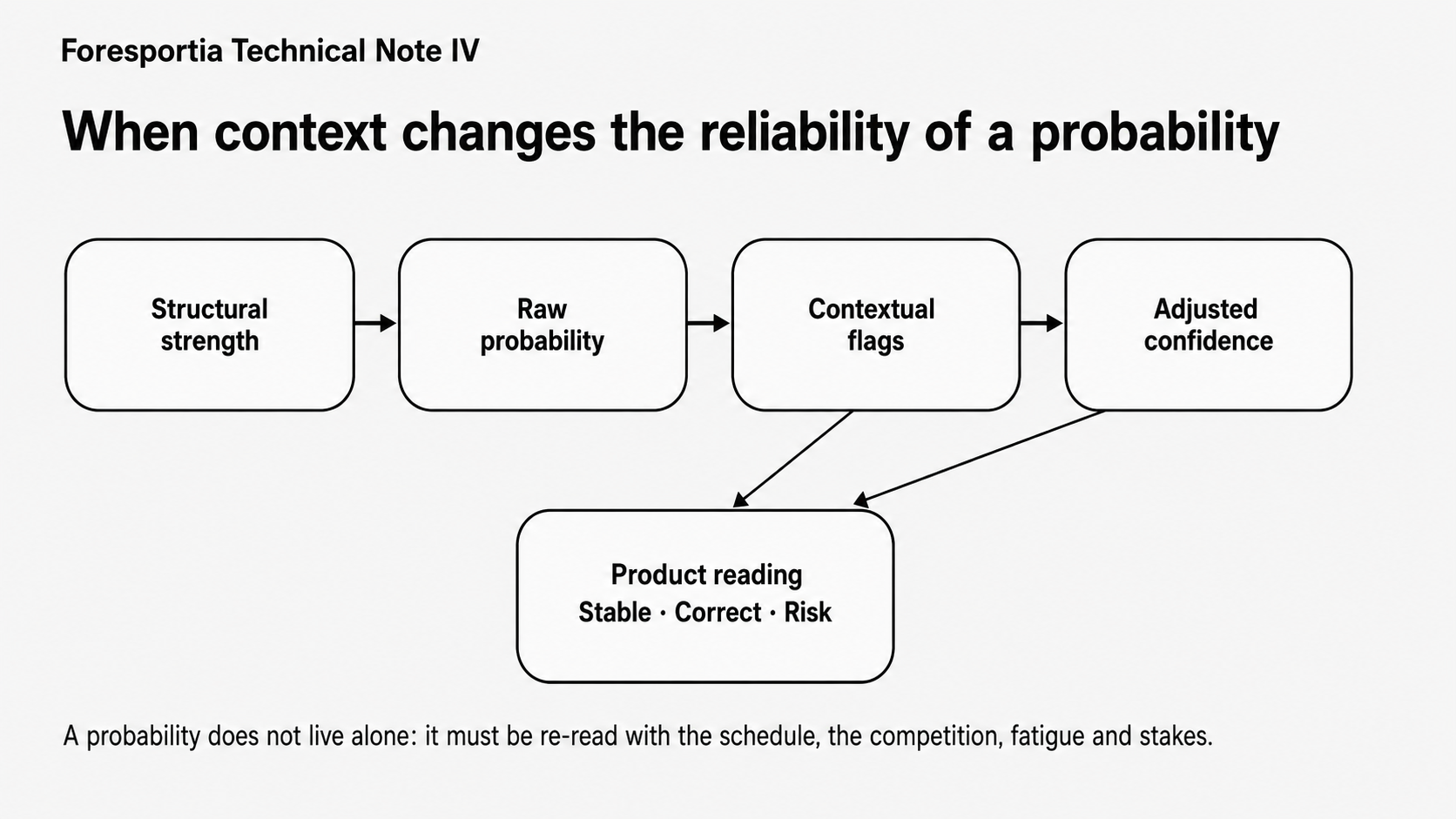
Core idea
A probability should not be read as if every match were played in neutral conditions. Fatigue, rotation, European fixtures, late-season stakes and ranking conflicts can make a statistically strong favorite less reliable.
Why context matters after probability and confidence
Technical Note III explained how Foresportia turns raw probabilities into confidence levels. This fourth note adds the next layer: context. A match can have a good-looking top probability and still be fragile because of the conditions around it.
Context is not a separate storytelling layer added after the model. It is part of the model’s interpretation. It helps decide whether the same probability should be trusted, downgraded or treated as a potential trap.
This note in the Foresportia Technical Notes series
1. Two identical probabilities can have different reliability
A 65% favorite in October and a 65% favorite in late May are not necessarily equivalent. The first may reflect a normal structural superiority. The second may involve rotation, asymmetric motivation, fatigue, or a team already focused on another objective.
This is why a probability must be read together with match context. Foresportia’s objective is not to add anecdotal commentary, but to prevent the model from treating every 65% probability as equally reliable.
2. Season progression changes the meaning of the data
A simplified season progression variable can be written as:
where J is the current matchday and Jmax is the expected number of matchdays.
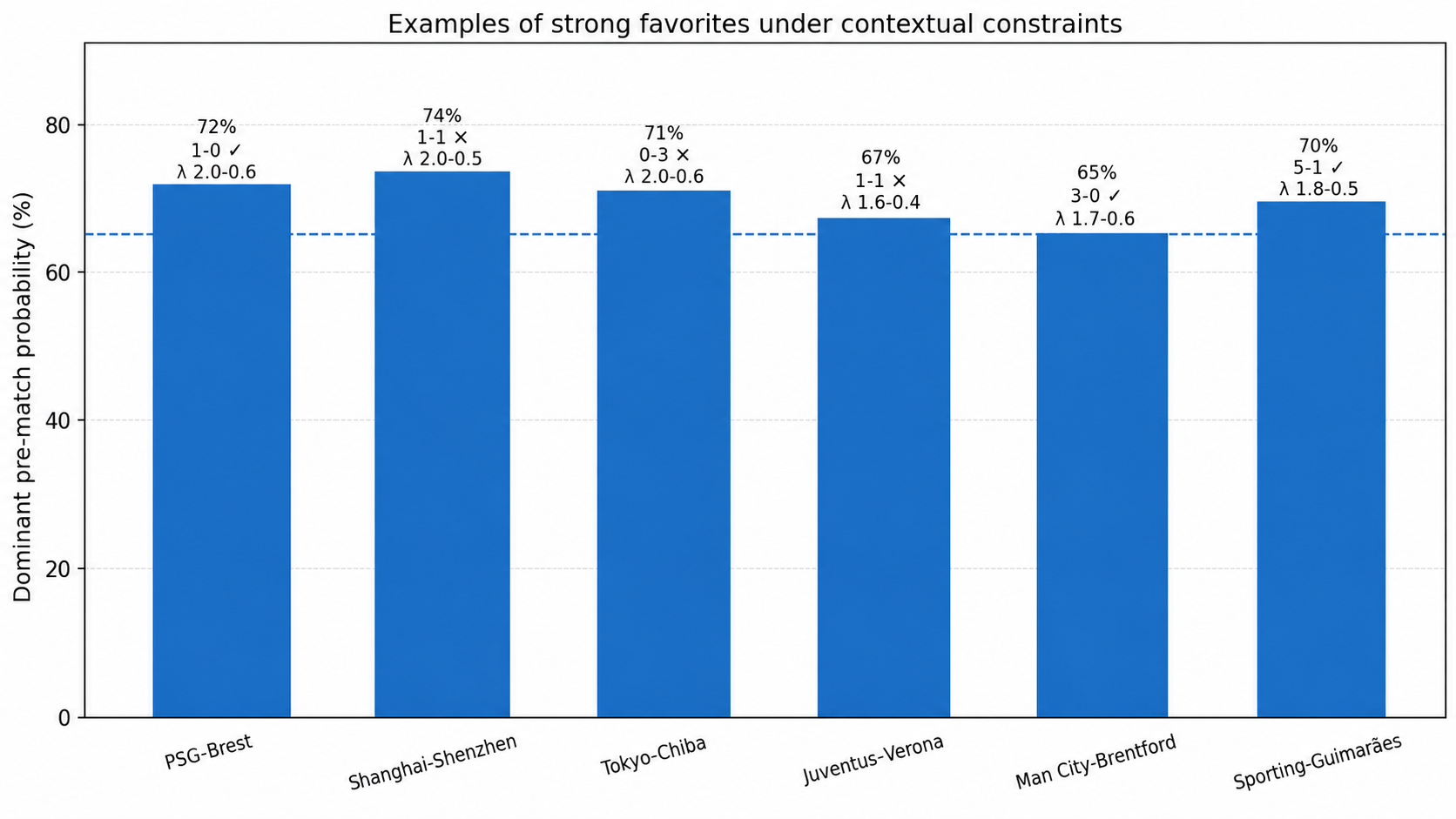
A rough interpretation is:
Early in the season, rankings may still be noisy. Late in the season, motivation becomes asymmetric: relegation pressure, European qualification, title race, fixture congestion and teams already safe can all distort a purely structural reading.
3. Fixture congestion and fatigue
Fatigue is difficult to measure directly, but fixture congestion provides a useful proxy:
A congestion flag can then be expressed as:
This does not mean a team automatically becomes weak. It means the model should be more cautious: pressing intensity, lineup continuity, defensive focus and finishing quality can all be affected by short rest.
4. Domestic form and European context are not the same thing
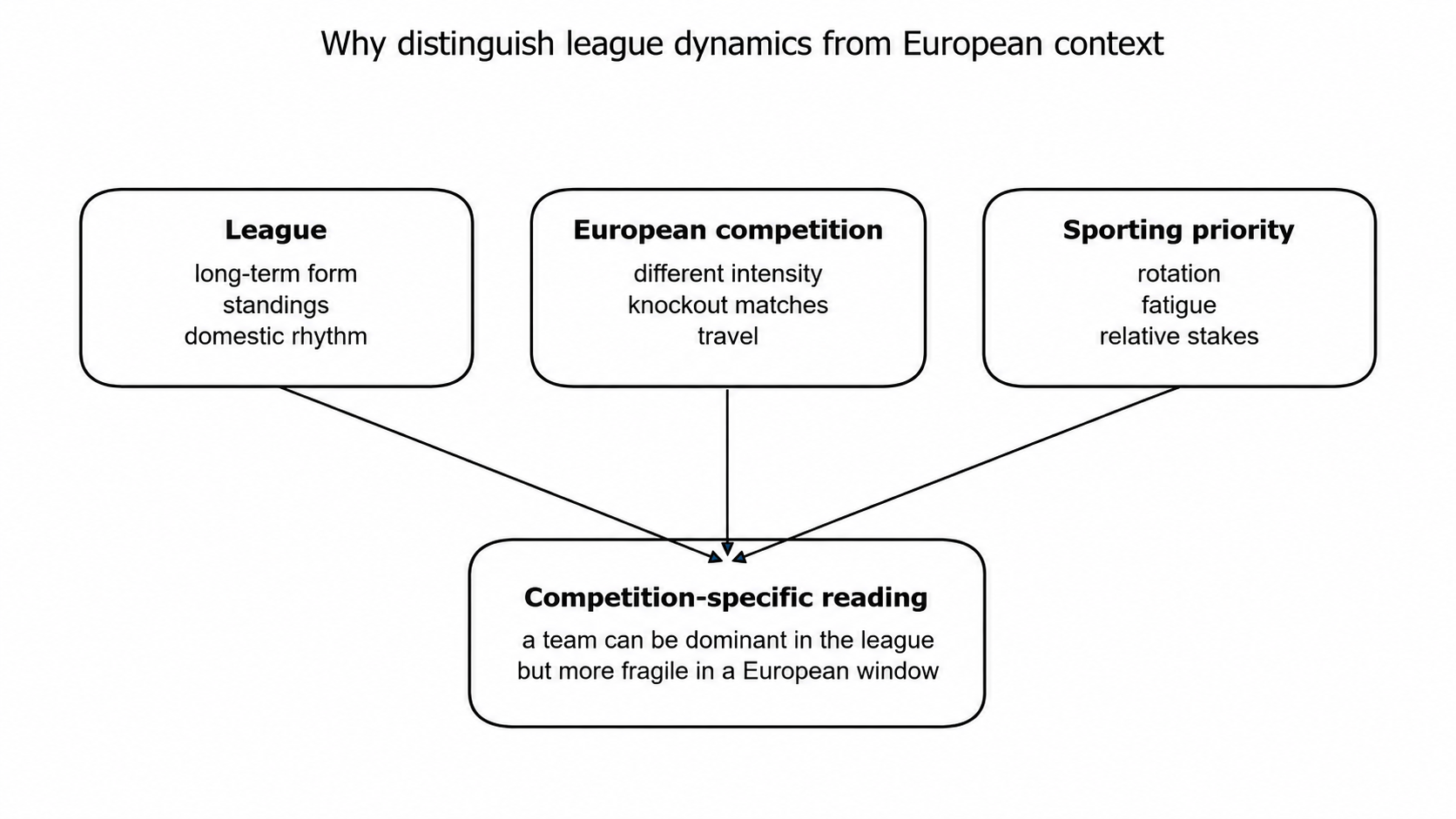
A team can look dominant in its domestic league while experiencing a very different rhythm in European competition. Travel, rotation, tactical level, squad management and psychological load can change the interpretation of recent form.
The goal is not to assume that European fixtures always hurt a team. The goal is to distinguish a normal league match from a match surrounded by a different competitive context.
5. Rotation risk: when lineup uncertainty weakens a favorite
Rotation risk is not only a lineup prediction. It is a contextual probability that the team on the pitch may differ from the structural team strength implied by historical ratings.
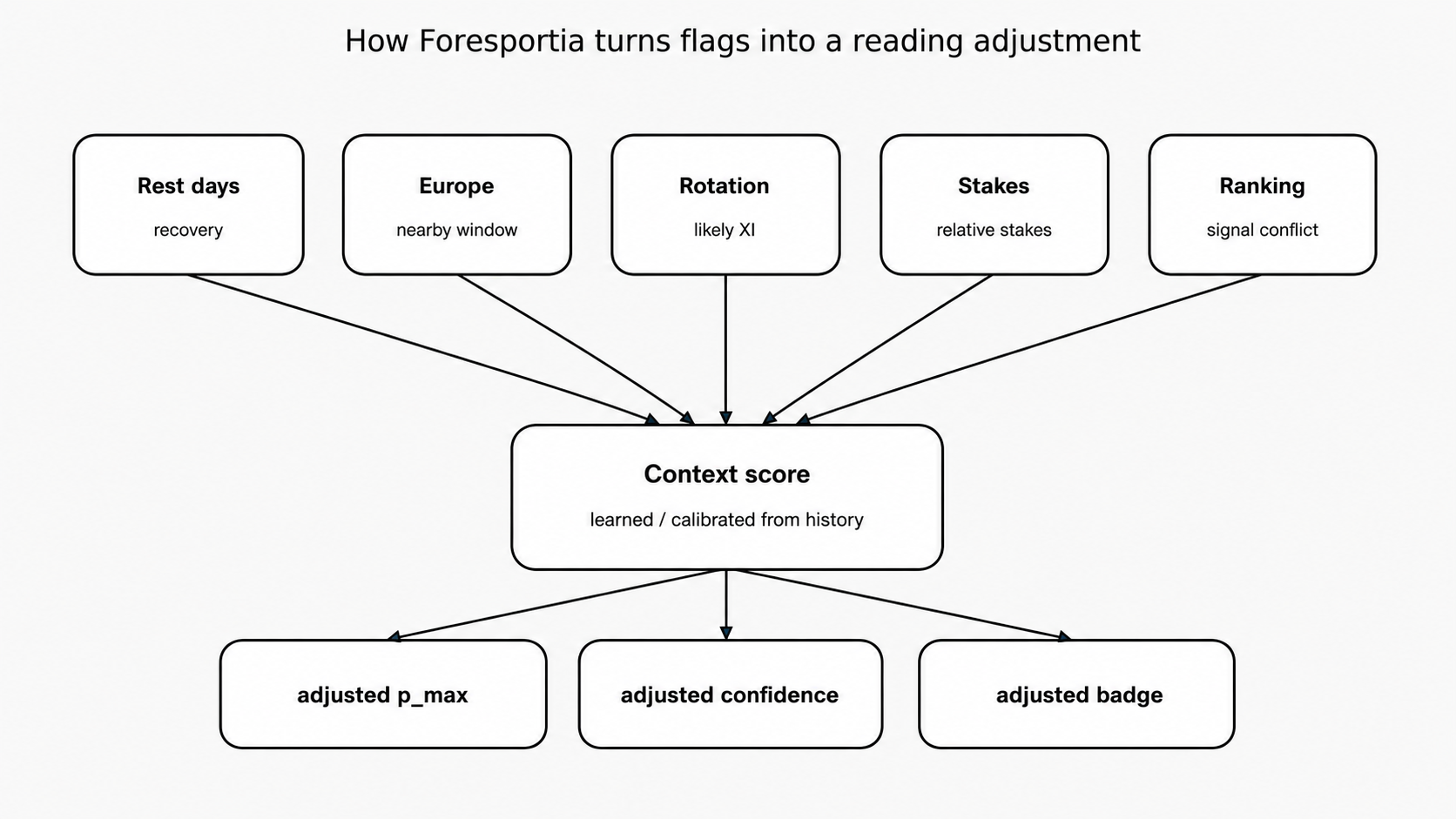
This score captures a simple idea: when a team has short rest, European obligations or reduced domestic stakes, the model should be careful before reading the favorite as fully reliable.
6. Stakes: title, relegation and qualification pressure
Late-season matches often involve asymmetric incentives. One team may be fighting relegation while the other is already safe. One team may need points for Europe while another can rotate.
A simplified distance to a critical zone can be written as:
A generic urgency score could then be:
The closer a team is to a critical zone, the stronger the potential pressure. This does not guarantee a better result, but it changes the context in which probabilities should be interpreted.
7. Examples: strong favorites under contextual pressure
Some matches are useful because they illustrate the difference between structural strength and match reliability. A top team can remain the favorite while the expected match shape becomes less aggressive than its usual profile.
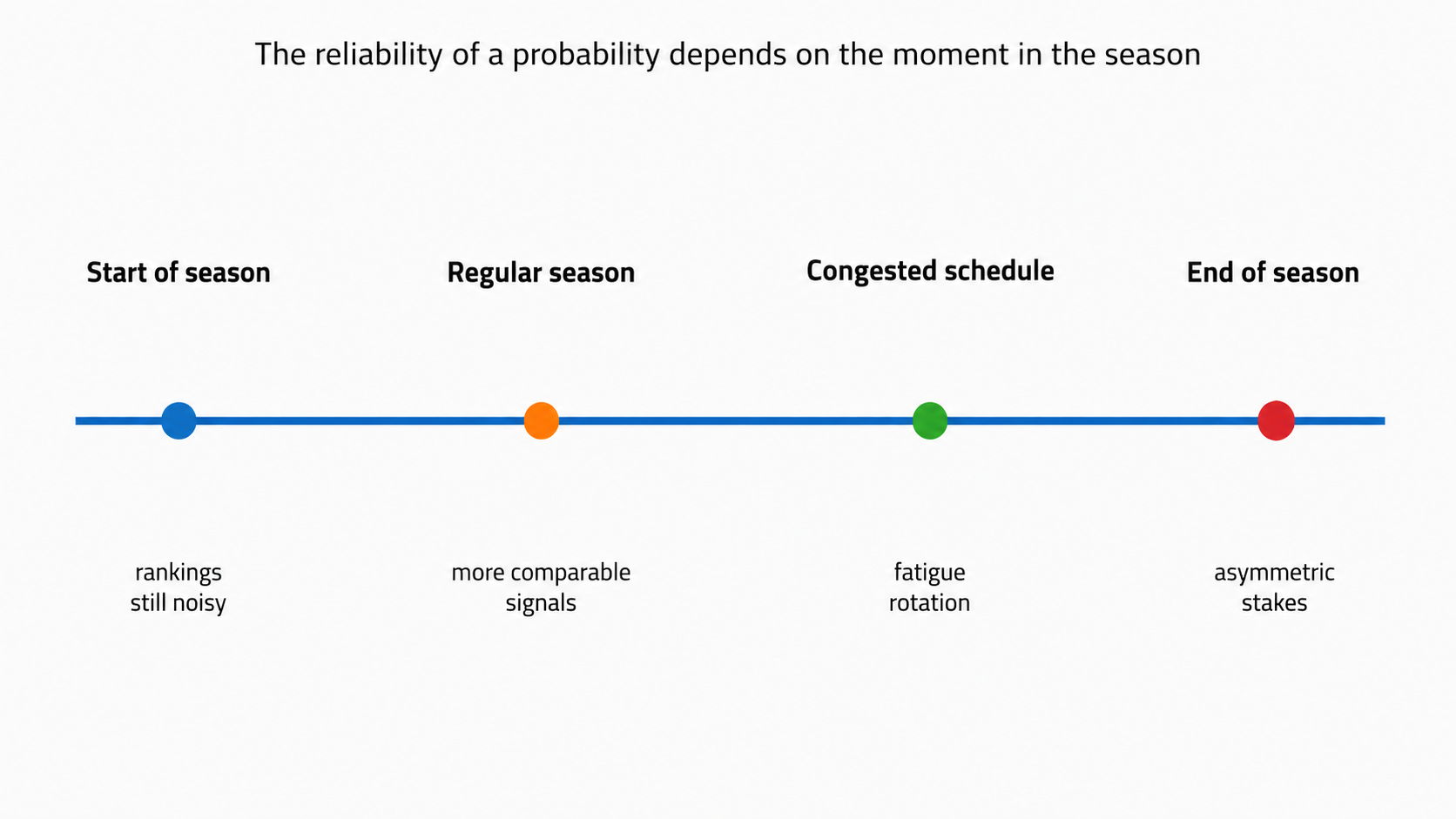
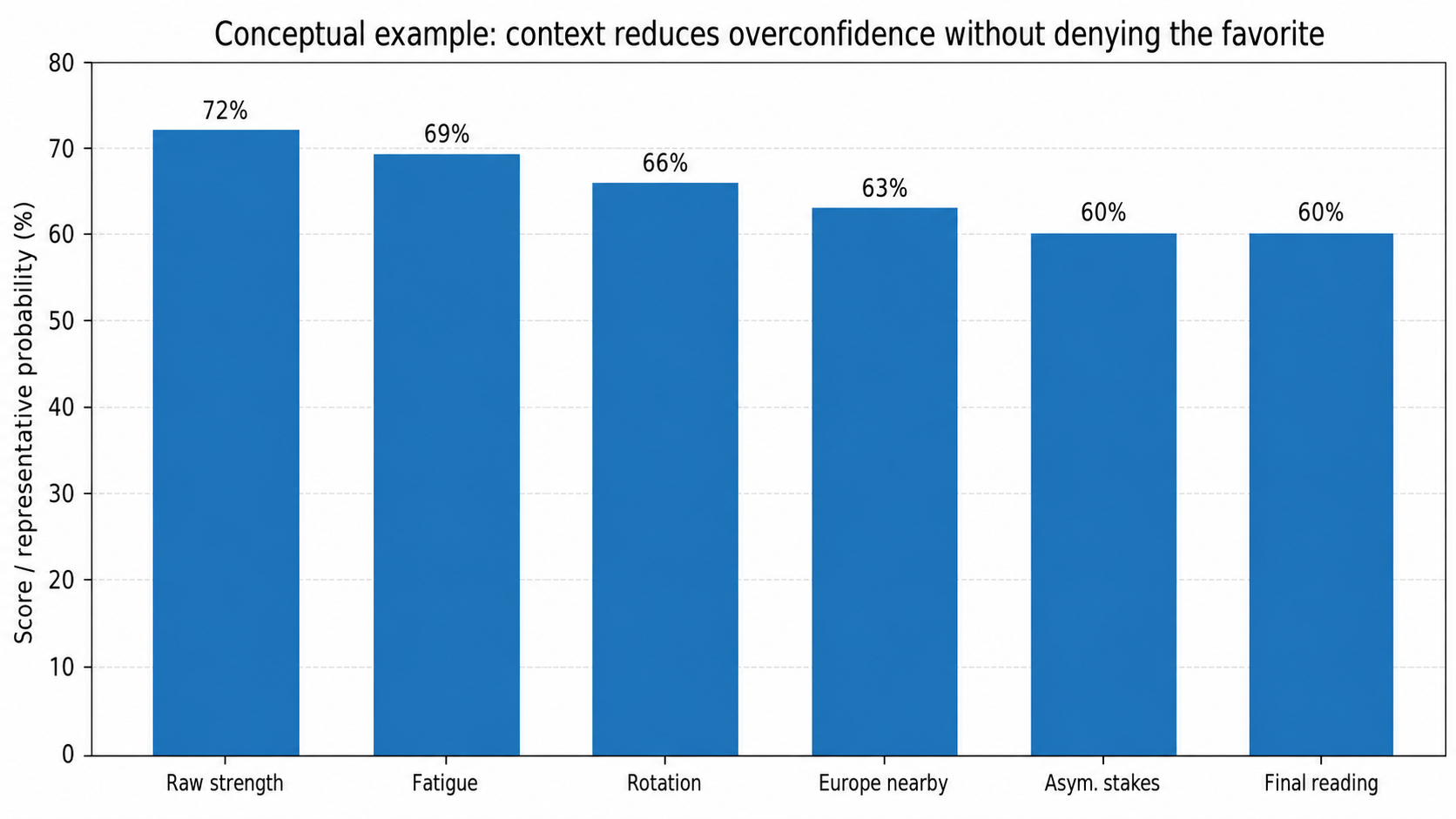
This is exactly the distinction Foresportia tries to capture: the model does not need to reverse every prediction. Often, the right action is to reduce confidence, lower the stability badge or adjust the expected goal profile.
8. Favorite traps: when a strong probability becomes fragile
A favorite trap occurs when the raw model identifies a statistically strong favorite, but context indicates that the signal may be less reliable than usual.
when several conditions combine:
- the team is a strong statistical favorite;
- the match occurs in a sensitive season phase;
- rotation, congestion or European proximity is present;
- stakes are asymmetric or unclear;
- ranking or form signals conflict with the raw favorite reading.
The trap does not mean the favorite should be predicted to lose. It means the confidence attached to the favorite must be reconsidered.
This simplified adjustment shows the logic: the probability may remain high, but its stability can be downgraded.
9. Where AI helps: combining weak contextual signals
Most context flags are weak alone. A European fixture close to a domestic match is not automatically negative. A team near the end of the season is not automatically unreliable. A congested schedule does not always imply a poor performance.
AI becomes useful because it can learn combinations. A single flag may be noise; several flags together may historically correspond to a systematic overconfidence zone.
This score can then influence confidence, badge stability or goal-market adjustments. The goal is not to invent a narrative, but to detect when similar contextual combinations have historically made the model too confident.
10. Context can also affect goal expectations
Context does not only affect 1X2 confidence. It can also change expected scoring intensity. A favorite may still be likely to win, but in a lower-tempo match, with reduced rotation continuity or more conservative game management.
This expression is illustrative, not a fixed public formula. It shows why goal markets and score scenarios can be affected by context even when the 1X2 favorite remains the same.
11. Limits: context is not a crystal ball
Context improves interpretation, but it must be used carefully. If every anecdote becomes a flag, the model becomes noisy. If context is ignored, the model becomes overconfident. The difficulty is to use context only when it is measurable, repeatable and empirically useful.
Foresportia therefore treats context as a reliability layer, not as a replacement for probabilities. Context can downgrade, qualify or explain a prediction. It should not become an excuse for arbitrary adjustments.
Conclusion: probability needs match context
This note explains why two matches with similar probabilities can have different reliability. Season phase, fatigue, rotation, European fixtures and stakes can all make a pre-match signal more fragile.
Key takeaway
Context does not replace probability. It changes how probability should be trusted. A strong favorite can remain the favorite while becoming a less stable prediction.
The next note focuses on goal markets: why BTTS, Over/Under and likely scores require a dedicated goal model rather than a naive derivation from 1X2 probabilities.
Quick FAQ
Does a context flag always change the prediction?
No. It often changes the confidence level rather than the predicted outcome.
Why are European fixtures important?
They can affect rotation, fatigue, preparation and tactical priorities, so they can change how reliable a domestic probability is.
What is a favorite trap?
It is a match where a team remains statistically favored, but contextual signals suggest the favorite is less reliable than usual.
Explore contextual signals in practice
See today’s probabilities, stability badges, AI selections and match context.
View today’s matches