In short
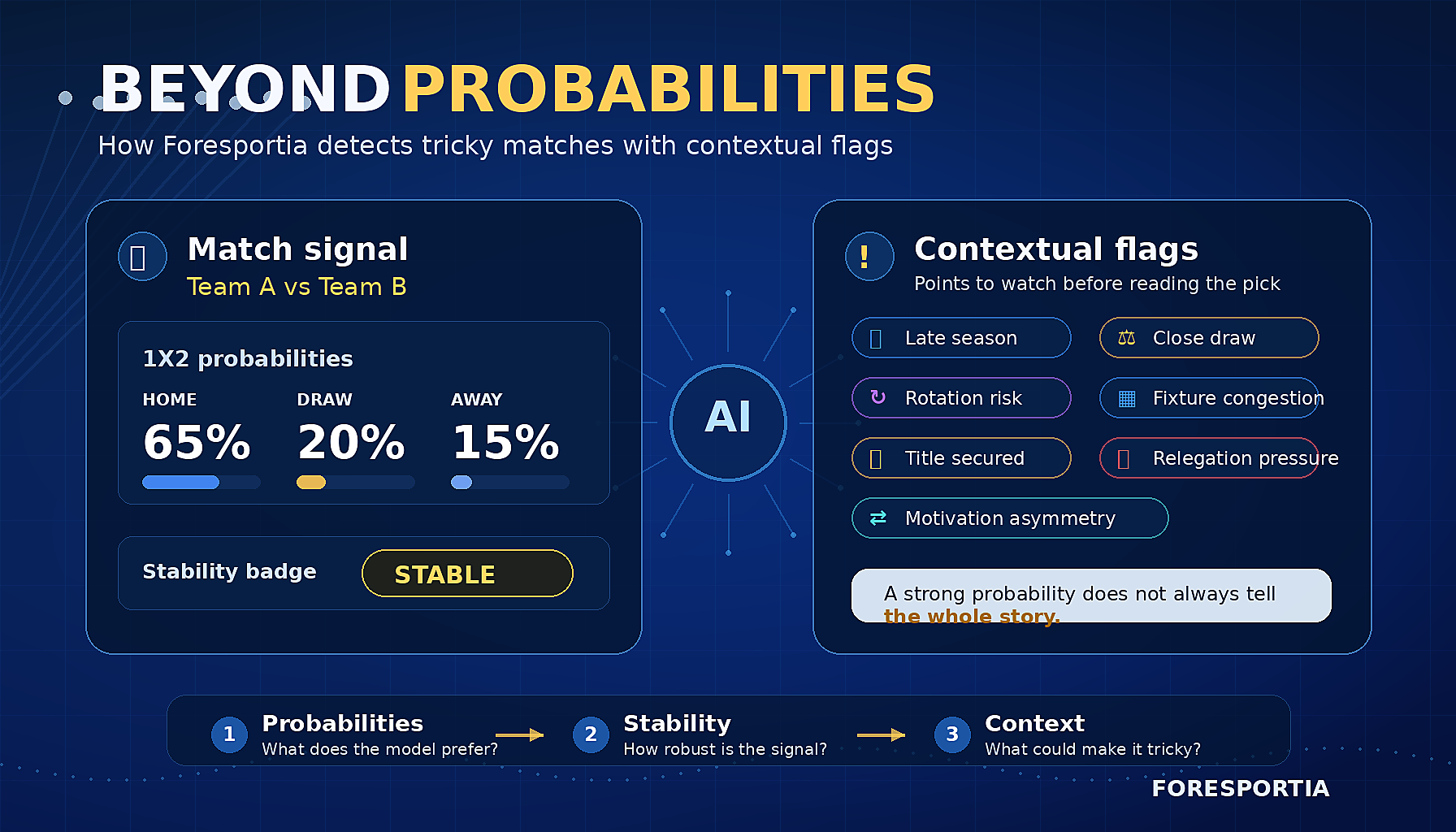
A 65% or 70% win probability does not always tell the whole story. The model can identify a clear favourite while also detecting warning signs linked to context: late season, fixture congestion, possible rotation, title already secured, relegation pressure or a long streak that looks fragile.
Core idea
The model already factors many of these effects into its calculations and its reliability estimate. But a contextual signal can stay minor or get diluted among many others. Flags do not bolt a crude manual correction on top: they make these effects explicit, so you have all the useful information when interpreting the match.
Why probability is not always enough
In sports prediction models, a football match is often summarised by three probabilities: home win, draw and away win. This is essential. Without this base, there is no quantitative reading of the match.
But this information remains incomplete. Two matches can have very similar 1X2 distributions while being radically different in their real-world context.
| 1X2 distribution | Possible context | Reading |
|---|---|---|
| Team A 65% Draw 20% Team B 15% | Team A is still fighting for the title at home. | The statistical favourite is also supported by a clear sporting objective. |
| Team A 65% Draw 20% Team B 15% | Team A has already won the title, has just played in Europe and is playing away. | The probability is still useful, but the match may be more fragile than the raw number suggests. |
The number is the same. The reading is not. This is exactly why Foresportia uses contextual flags.
The real question: is the match trickier than the raw probability suggests?
A 1X2 probability answers a first question: “based on available data, which outcome looks most likely?”. But users often need a second reading: “is there a contextual element that makes this prediction harder to interpret?”.
Football is sensitive to season timing, open objectives, squad management, schedule density and European fixtures. These factors should not necessarily be transformed into brutal probability corrections. However, they can justify a warning signal.
Away favourite: 69%. Draw: 20%. Opponent: 11%. On paper, the favourite is clear. But if that favourite has already secured the title, is playing away, comes from a congested schedule and faces a team still under relegation pressure, the match should no longer be read as a standard favourite.
Stability badges and contextual flags: two different layers
Before discussing flags, it is important to separate two types of information. Stability badges describe the statistical structure of the prediction. Contextual flags describe warning points linked to the match environment.
| Layer | What it measures | What it does not say |
|---|---|---|
| Very stable | Highly concentrated 1X2 distribution. The main outcome clearly dominates the alternatives. | Does not mean the context is risk-free. |
| Stable | Clear advantage for the main outcome, with a solid probabilistic structure. | Does not guarantee that calendar, rotation or incentives are neutral. |
| Correct | The model has a preference, but the match remains open. | Should not be read as a strong recommendation. |
| Risk | The preference is too fragile or the distribution too uncertain. | Does not mean the match is uninteresting, only that the statistical signal is weak. |
The essential point is this: the stability badge describes the statistical signal. It should not carry the whole interpretation of the match on its own.
Why entropy does not see everything
Foresportia uses entropy to measure the dispersion of a 1X2 distribution. A balanced distribution has high entropy. A distribution dominated by one main outcome has lower entropy.
| Distribution | Reading |
|---|---|
| Home 35% · Draw 32% · Away 33% | Very dispersed distribution: the model sees an open match. |
| Home 70% · Draw 19% · Away 11% | More concentrated distribution: the favourite dominates the alternatives more clearly. |
Entropy is therefore very useful. But, taken on its own, it does not by itself sum up external effects such as a title already secured, a team already relegated, relegation pressure, likely rotation, a nearby European fixture or asymmetric end-of-season motivation. These effects are still accounted for elsewhere in the calculations and in the reliability estimate; they can simply stay minor there.
Foresportia distinguishes two readings: statistical stability, carried by probabilities, entropy and badges; then a transparency layer, the contextual warning points, which surface effects already weighted by the model but sometimes drowned out among other signals.
The main Foresportia contextual flags
On match cards, these warning points appear as small coloured badges (“Context watch”). They do not replace probabilities. Their role is to say: “these are the elements that can make the match reading more fragile”.
| Badge shown | What it signals | Possible user-facing text |
|---|---|---|
| Late season | The match is played in an advanced stage of the league season. | The match arrives late in the season, a period where incentives and rotations can matter more. |
| Draw close | The draw remains close to the favourite in the model distribution. | The draw remains close to the favourite in the model distribution. |
| High draw risk | The draw puts strong pressure on the favourite: the draw probability is close to the leading side. | High draw-risk match: the favourite remains ahead, but the draw is close enough to make the reading fragile. |
| Streak to monitor | The selected team is on a very long streak. | This can reflect strong form, but it deserves extra caution. |
| Fragile streak | The selected team is unbeaten over a long run, but recent form does not look like clear domination. | The risk of a draw or a break in momentum is higher, even if the statistical favourite remains the favourite. |
| Lineups to watch | One of the two teams shows a possible rotation or squad-management risk. | A dense schedule for the team concerned may increase rotation or intensity-management risk and make the match reading less reliable. |
| Dense schedule | Recent or nearby fixtures may influence fatigue, lineup or intensity. | When both teams are concerned, the signal does not clearly favor either side, but it increases uncertainty around lineups and match intensity. |
| European fixture | A nearby European match may affect club priorities. | A nearby European fixture can influence squad management. |
| Fragile away favorite | An away favourite appears in a late-season context with several warning signs. | The away favorite remains stronger on raw data, but its context can make the prediction less stable. |
| Favorite trap | The favourite (home or away) sits in a fragile late-season context. | The favourite sits in a fragile end-of-season context; read the probability with extra caution. |
| Title secured | A team has mathematically secured the title. | The title-winning team has lower immediate stakes, which may make lineup choices or match intensity less predictable. |
| Already relegated | A team can no longer mathematically avoid direct relegation. | This team is already mathematically relegated: motivation, lineup or intensity may differ from a standard match. |
| Relegation pressure | A team is still fighting to avoid relegation or is close to the danger zone. | This team is still under relegation pressure: intensity and match scenario may be influenced by that objective. |
| Motivation gap | The two teams appear to have different levels of sporting stakes. | This mainly indicates a possible motivation asymmetry, not a guaranteed advantage for either side. |
| Context adjusted | A cluster of contextual signals strong enough to reduce the product reliability of the prediction. | Strong statistical signal, but contextual signals reduce the product reliability of this prediction. |
| Second leg | The match is the return leg of a two-legged tie. | The first-leg score and qualification scenario change the tactical reading; this badge has top priority. |
| Final | The match directly decides the competition winner. | A final carries maximum stakes and a different context from a regular-season fixture. |
| Semi-final | The match belongs to the final four. | Shown when space remains after more important signals. |
| Playoff | The match belongs to a playoff phase. | The result may decide qualification, promotion or a title depending on the format. |
| Group stage | The match belongs to a cup competition's group stage. | May be shown to situate a cup fixture without displacing a more useful warning. |
| Knockout | Generic fallback when a knockout context is known but no precise displayable phase is available. | Suppressed whenever a precise badge such as Final or Playoff is already shown. |
Depending on the competition format, additional badges may also appear: Playoff stakes, Transition season, Complex relegation or Special format. They are described below, in the league-format section.
Late season: when matches become less standard
The Late season badge is deliberately simple: it signals that the match is taking place in an advanced phase of the league season. On its own, it is not enough to downgrade a prediction. But it changes the reading of the match.
Some teams are still fighting for the title, Europe or survival. Others have already reached or lost their objective.
A team may manage its squad, prepare a final or give time to less-used players.
A team under pressure may accept a draw, sit deeper or take more risk depending on the table.
This is why late season becomes especially useful when combined with other signals: away favourite, fixture congestion, possible rotation or relegation stakes.
Close draw: the invisible top-pick trap
The Draw close badge is important because the draw is a special football outcome. It is often highly present in the distribution, but rarely the model’s top outcome.
A match can therefore have a displayed favourite while remaining fragile because the draw is close. When that pressure becomes stronger, Foresportia shows High draw risk as a strong warning point, at the same reading level as a derby or another especially exposed context.
| Distribution | Raw reading | Reading with flag |
|---|---|---|
| Home 38% · Draw 31% · Away 31% | Home is the top pick. | The match is almost balanced. The draw is close enough to make the signal fragile. |
| Away 44% · Draw 30% · Home 26% | Away is favourite. | The favourite exists, but the draw remains a strong alternative. |
Foresportia can naturally under-represent the draw as the main outcome, because the draw is often second rather than first. The flag does not turn the pick into a draw, change probabilities or downgrade the badge: it reminds users that the main preference can be fragile.
Long streaks: real form or regression signal?
Foresportia also adds a contextual reading of streaks for the team selected by the model. The goal is not to display “positive momentum” everywhere, because short streaks are usually already captured by form data. The useful layer is to isolate two more specific cases.
The run is very long. It may reflect genuine strength, but it deserves extra caution, especially when the match comes in a dense or late-season phase.
The selected team is unbeaten over a long run but has not won many of its latest matches. The signal becomes closer to a draw or regression risk than to clear domination.
A basic active streak is not displayed on its own. It remains useful internally, but Foresportia avoids adding a visible badge when the signal does not add enough caution.
One match can show only one streak signal: Fragile streak ranks above Streak to monitor. If only the shorter positive momentum signal is present, no streak badge is shown.
Lineups, dense schedule and Europe: squad-management signals
These badges try to identify matches where lineup or intensity may be less predictable.
- Lineups to watch — turnover or squad-management risk on one of the two teams.
- Dense schedule — recent match or upcoming match, possible fatigue.
- European fixture — a nearby European fixture that may modify priorities.
These signals do not say that a team will definitely rotate. They only indicate that the context makes that hypothesis more plausible and can make the match reading less stable.
A nearby European fixture does not automatically make a team weaker. It may even mean the team is excellent. But it can change minutes management, intensity or starter selection.
Fragile away favourite: a particularly sensitive case
The Fragile away favorite badge targets a specific situation: an away favourite late in the season, with contextual signals that may make the match trickier than the raw probability suggests.
This type of match is subtle. The favourite may remain the model’s best choice. But several elements can increase real-world risk: away trip, squad management, more motivated opponent, fixture congestion, nearby European match or draw still visible.
The favorite remains the favorite on raw probabilities, but the context makes the prediction less stable: away status, late-season dynamics and a dense schedule may affect lineup choices or intensity.
The goal is not to automatically downgrade every away favourite. The goal is to distinguish the statistically clear favourite from the statistically clear but contextually exposed favourite.
Secured title, relegation and survival pressure
Foresportia also adds flags related to mathematical or near-mathematical team statuses. These signals matter because they directly affect competitive motivation.
Title already secured
The Title secured badge indicates that a team has mathematically secured the title.
Example: if Porto has 85 points, Sporting CP has 79 points and one match remains, then 85 > 79 + 3. Porto is mathematically champion.
Already relegated
The Already relegated badge indicates that a team can no longer mathematically avoid direct relegation.
Relegation pressure
The Relegation pressure badge indicates that a team is still fighting for survival or remains close to the danger zone.
| Matches remaining | Relegation-pressure threshold | Reading |
|---|---|---|
| 1 to 2 | 3 points | The pressure is immediate: every point can matter. |
| 3 to 5 | 6 points | The danger zone remains close enough to influence the match approach. |
Motivation asymmetry: the clearest contextual signal
The Motivation gap badge is composite. It activates when the statuses of both teams are reliable enough and their sporting stakes appear different.
One team has already settled its main objective, while the other is still fighting for sporting survival.
One team has a settled status, while the other remains under immediate pressure.
The signal should explain which side has lower immediate stakes and why, then present the other side as relatively more motivated, not automatically advantaged.
This is one of the most important flags, because it describes more than possible fatigue or rotation. It describes a potential difference in competitive stakes between the two teams.
How these effects are already taken into account
These effects are not ignored: the model already factors them into its calculations and its reliability estimate. What Foresportia avoids is a crude manual correction bolted on top, such as “team already champion → −10% probability”. A rule that coarse would be misleading.
A team that has already secured the title can still play seriously, celebrate in front of its fans, maintain a streak, prepare a final or have a bench stronger than the opponent. Similarly, a relegated team can play with freedom, give minutes to motivated young players or try to finish with pride. The real effect is therefore rarely mechanical: it is often genuinely present, but minor, and can be diluted among many other signals.
These effects are weighted upstream by the model and the reliability layer; the flags add explicit transparency, so you clearly see a signal that might otherwise go unnoticed. Calibration metrics (Brier score, log loss) stay continuously monitored to tune that weighting over time.
Three examples of match reading
1. Strong favourite, fragile context
Imagine a match Paris FC vs PSG:
| Outcome | Probability |
|---|---|
| Paris FC | 14% |
| Draw | 21% |
| PSG | 65% |
The raw probability makes PSG the favourite. But if Foresportia detects late season, fragile away favourite, lineups to watch and dense schedule, the proper reading becomes: PSG remains favourite, but the prediction is less stable because of possible lineup, intensity or match-management effects.
2. Team already champion
If Porto is mathematically champion, the probability can still show Porto as favourite. That is logical: Porto remains a strong team. But the user should know that the title is secured, because this can influence intensity, lineup, rotation or rhythm management.
Porto has already secured the title. Their immediate sporting stakes are lower, which may make lineup choices or match intensity less predictable. The opponent may have stronger relative motivation.
3. Relegation and survival pressure
A team already relegated facing a team still under relegation pressure creates a different reading. The model may statistically prefer one side, but the context shows that competitive incentives are asymmetric.
The already relegated team has lower immediate stakes. This signal mainly indicates a possible motivation asymmetry, not a guaranteed advantage for the opponent.
How flags are displayed to users
The goal is not to overload match cards. A user should quickly understand the hierarchy of information.
Warning points Second leg · Final · Derby
A card keeps no more than three badges and surfaces the information that materially changes how the match should be read.
Complete phase data, selective on-card display
The canonical competition context keeps every recognised phase: qualification, group stage, round of 16, quarter-final, semi-final, final, playoff, regular season, Apertura and Clausura. They remain useful in the API, SEO, match title or match details. They do not all become primary badges automatically.
- Always prioritised: Second leg.
- Visible: Final and Playoff; Semi-final when space allows.
- Competition-dependent: Group stage may appear for cup competitions.
- Better suited to details: Round of 16 and Quarter-final.
- Descriptive metadata: Qualification, Regular season, Apertura and Clausura normally do not consume a primary badge.
- Fallback only: Knockout is shown only when no precise phase is already displayed.
A card never shows “Final + Knockout” or “Quarter-final + Knockout”. After Second leg and a possible decisive phase, remaining slots go to the most useful signals: derby, sporting stakes or a quality warning.
Why this approach is more transparent
In many prediction systems, the user only sees: “Team A: 64%”. But they do not know whether that 64% is statistically stable, fragile because of the calendar, exposed to a close draw, linked to an unusual late-season context or influenced by asymmetric incentives.
Foresportia tries to make this reading more transparent. The goal is not to perfectly predict every trap. That is impossible. The goal is to indicate when some elements make the prediction more delicate to interpret.
Probabilities answer “which outcome is most likely?”. Badges answer “how stable is that signal?”. Flags answer “which contextual elements should be checked before interpreting this match?”.
What recently changed
Until now, stake-related flags (title secured, already relegated, relegation pressure, motivation asymmetry) were computed on a small set of leagues where the table reads directly. That was deliberately cautious, but it left a blind spot: a league missing from the perimeter did not necessarily mean “no stakes”, it could simply mean “a format too specific to be read like a classic Premier League run-in”.
Foresportia now extends its contextual layer to every domestic league known to the model. Each league is typed by its format (regular league, split league, playoff league, transition season, coefficient-based relegation, etc.). The goal is not to add noise, but to separate three cases that used to be mixed:
- Supported league with reliable reading — stake flags can be displayed confidently.
- Known league but not currently computable — the format does not allow a simple signal to be derived from the table alone.
- Competition excluded by nature — cups and tournaments (Champions League, Europa League, Conference League, World Cup 2026) are not handled by league-stake flags.
The absence of a strong flag does not always mean the absence of stakes. It can also simply mean that the league format does not lend itself to a clean title/relegation reading at this particular moment of the season.
Not every league has the same format
Reading the end of an MLS, Belgian or Argentine season the same way as a Premier League run-in distorts the picture. Foresportia now identifies the format of each competition to interpret the table with the right lens, and some formats trigger dedicated badges on match cards.
| League format | What it describes | Indicative examples |
|---|---|---|
| Regular league | Classic round-robin championship. Title and relegation reads are fairly direct when data is reliable. | Premier League, La Liga, Serie A, Bundesliga, Ligue 1. |
| Regular league with playoff | Regular season with a promotion or relegation playoff at the end. | Several European second divisions. |
| Split league Special format | Regular phase followed by a split into a championship group and a relegation group. The raw table does not tell the whole story — the season phase matters. | Belgium, Switzerland, Scotland, Denmark, Finland, Austria, Czech Republic, Romania, South Korea. |
| Split league in transition Special format | Split-format league running a transition season or temporarily modified rules. | Competitions in format reform. |
| Playoff league, no relegation Playoff stakes | No classic relegation: the main late-season stake is usually the playoff race. | MLS, Liga MX, A-League, Canadian Premier League. |
| Transition season, no relegation Transition season | Special season where classic relegation does not apply (calendar change, restructuring). | J1 League 2026. |
| Coefficient-based relegation Complex relegation | Relegation computed from multi-season averages or coefficients, so it cannot be reduced to the current standings alone. | Argentine top tiers. |
| Cup or tournament | Competition excluded from the league-stake module (no title/relegation in the table sense). | Champions League, Europa League, Conference League, World Cup 2026. |
The goal is not to over-interpret every match, but to avoid reading the end of an MLS, Belgian or Argentine season as if it were a classic Premier League run-in.
Why a warning point may not appear
Alongside the league format, Foresportia evaluates the reliability of the context before showing a warning point. The question is simple: do we know enough about this competition for a title, survival or motivation signal to be interpretable? If the answer is no, it is better to show nothing than to show a misleading signal.
Foresportia first looks at how the league ends: direct championship, split, playoffs, transition season, coefficient-based relegation. This prevents applying a Premier-League lens to a competition that does not follow that logic.
The reading can depend on the current phase (for example before or after a split). A signal valid in the regular phase may no longer be valid in the final phase.
Foresportia checks whether “title”, “relegation” or “playoff qualification” actually mean something in this league at this moment. If not, the matching badge is not proposed.
A global confidence check decides the borderline case: when data is not sufficient, Foresportia deliberately avoids displaying a strong stake badge, even if a naive heuristic could have triggered one.
For each match, the system keeps the reason why a signal was kept, softened or suspended. That is useful to audit the model on an atypical season, but it is not shown to users.
A match can perfectly well show a high probability while having a fragile context. Conversely, the absence of a strong warning point does not always mean the absence of stakes — it can simply mean that the league format does not allow a reliable stake signal at that moment.
This is the separation Foresportia is progressively building: (1) the statistical probability, (2) the stability of the signal, (3) the competition context, and (4) the editorial interpretation that follows. Four layers, readable independently.
Derbies and rivalries: a new context signal
Foresportia adds a new context layer dedicated to derbies and rivalries. It is a transparency layer: it does not bolt a manual correction onto the 1X2 probability. A derby's intensity may already show through in the data; this signal mainly exists to flag it clearly to you and to explain why a fixture can be more intense, more emotional or less predictable than a standard fixture.
Two levels are surfaced, mirroring the rest of the context watch:
Shown as a genuine warning point. Reserved for historic, high-intensity rivalries such as Barcelona – Real Madrid, AC Milan – Inter Milan, Arsenal – Tottenham, PSG – Marseille, Flamengo – Fluminense, and other major city derbies.
Displayed more discreetly, as additional context. Covers secondary rivalries or fixtures where the editorial intensity is real but lower than a flagship derby.
No automatic detection by geographic distance, no partial name matching, no guessing. The system relies only on a curated editorial base of validated rivalries. If the context is not deemed reliable, nothing is shown publicly.
This signal does not say that a surprise result is coming. It simply indicates that the match carries an emotional or historical context that may make the reading more delicate. The statistical favourite remains the statistical favourite.
In terms of display hierarchy, a major rivalry ranks above weaker structural context (split, no-relegation, transition season), while a “special fixture” stays a complementary, discreet hint. Foresportia continues to cap the number of warning points shown on a card to avoid visual overload.
Assumed limits
These flags remain cautious. They do not say that a team will definitely rotate, lose or draw. They say that the context deserves attention.
- Flags are not betting advice.
- They do not replace the raw probability.
- They do not guarantee that a trap will happen.
- They are activated only when available data supports a sufficiently reliable reading.
Some competitions are excluded by nature from the league-stake module: cups and tournaments (Champions League, Europa League, Conference League, World Cup 2026). For domestic leagues, Foresportia now explicitly separates an unsupported league from a league that is supported but not currently computable (split in progress, transition season, coefficient-based relegation). In the second case, the system prefers to display no strong stake flag rather than produce a misleading signal.
Foresportia favours limited but reliable detection rather than broad and approximate coverage. It is better to display fewer flags and avoid artificial alerts.
Conclusion: a more useful AI when it also explains caution zones
Sports prediction cannot be reduced to one probability. A probability is an essential foundation, but it should be accompanied by contextual reading.
With contextual flags, Foresportia adds an interpretation layer: what does the model say? How stable is the signal? Which elements can make the match trickier?
This separation matters: the model already factors these effects into its calculations and reliability estimate, badges measure statistical stability, and warning points make sometimes-minor but useful signals visible, in full transparency.
It is a step toward a more transparent prediction AI: not an AI that pretends to know everything, but an AI that also shows what deserves caution.
Next: Top AI predictions · Past results · Very stable badge
FAQ: Foresportia contextual flags
Does a contextual flag mean the prediction is wrong?
No. A flag only indicates that one contextual element deserves attention before interpreting the raw probability.
Does the model ignore these effects?
No. These effects are already taken into account by the model and its reliability estimate. What we avoid is a crude manual correction bolted on top: a team that has already secured the title can still play seriously, and a relegated team can play freely. Flags make these signals explicit, for transparency, because they can stay minor among many others.
What is the difference between a stability badge and a contextual flag?
The badge describes the statistical structure of the prediction: entropy, margin, confidence and distribution concentration. The flag describes an external warning point: calendar, rotation, survival stakes, secured title or motivation asymmetry.
Are flags available on every match?
No. They depend on data quality and competition format. Some leagues or season phases are deliberately less covered when detection would be too fragile.
Does a derby change the displayed probability?
The derby signal is an editorial transparency layer: it does not bolt a manual correction onto the 1X2 probability or the stability badge. Such a fixture's intensity may already show through in the data; the signal mainly exists to flag clearly to you that a match such as AC Milan – Inter Milan or Flamengo – Fluminense can be more intense and less predictable than a standard fixture.