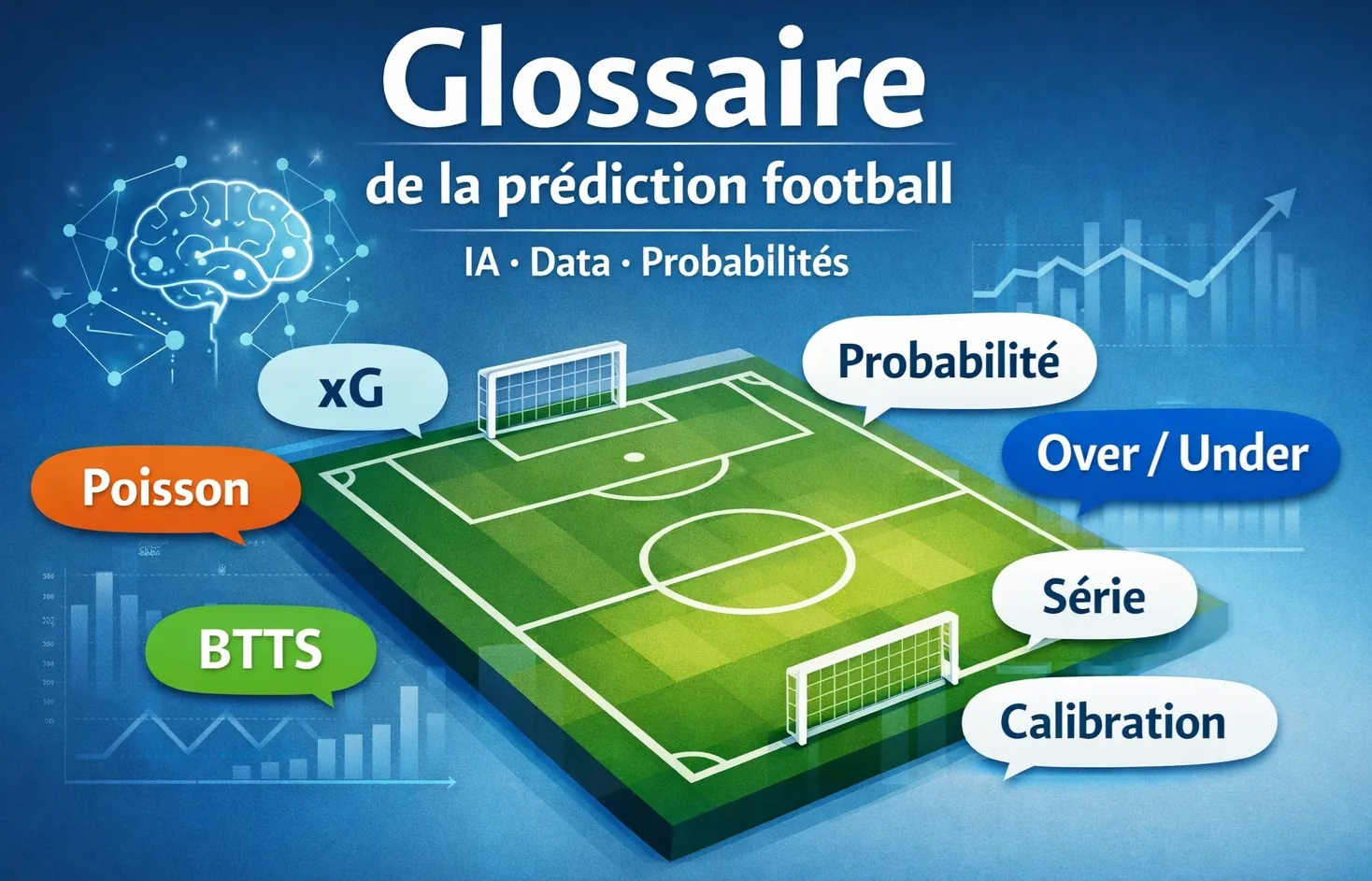
What is this glossary for?
Foresportia articles sometimes use “data” vocabulary. This page provides a clear definition of each term, with one goal: understand a match more effectively. Foresportia is an analysis support tool (educational): no promises, no certainty.
How to read this glossary
Each definition focuses on the essentials, then provides a “match-language” translation. If you want the full methodology: Football prediction AI (pillar page).
Probabilities & match scenarios
Probability
A probability measures how likely an event is (between 0% and 100%). Example: “home win 55%” means the most likely scenario, not a guaranteed result.
1X2
Standard match reading: 1 = home win, X = draw, 2 = away win.
Double chance (1X, X2, 12)
Groups two possible outcomes (e.g., 1X = home win or draw). In probabilities, it is simply an addition of scenarios.
DNB (Draw No Bet)
“No draw”: we reason as if the draw outcome is neutralized. Translation: if a team wins, which one is more likely?
Margin / uncertainty
Even with a strong model, football remains uncertain (few goals, rare events). The right mindset: a probability gives a direction, not certainty.
Goals, scores, and “match-level” reading
Over / Under (e.g., 2.5)
Compares total goals to a threshold. Over 2.5 = 3 goals or more; Under 2.5 = 0, 1, or 2 goals. A simple way to describe a tight vs open match.
BTTS (Both Teams To Score)
“Both teams score”. Useful to describe matches where both teams have a non-negligible chance of scoring.
Exact score
Probability of one specific scoreline (e.g., 2–1). Exact score is very sensitive: a small detail can shift the outcome cell (2–0, 1–1, 3–1...). Best practice: look at the top 3–5 scorelines, not a single score in isolation.
Dedicated read: Exact score: rarity & uncertainty
Statistics & indicators
xG (Expected Goals)
An estimate of how likely a shot is to become a goal (chance quality). xG helps analyze performance (who created the best chances), without confusing “performance” with “result”.
Form
An indication of a team’s recent momentum (results, goals, streaks). Caution: a short streak can be misleading—treat it as a signal, not a rule.
Streak (wins, losses, unbeaten runs)
A sequence of similar results. Helpful for context (confidence, pressure), but fragile when the sample is small.
Practical page: Team form & streaks
Statistical models & AI
Statistical model
A mathematical tool that turns data into probabilities. A model does not “guess”: it estimates likelihoods using observed regularities.
Poisson
A classic model to estimate rare event counts (such as goals). Useful as a baseline, but football models often add adjustments (home advantage, styles, correlations).
Simulations
A technique that generates many “virtual” matches from probabilities, to obtain a distribution of scores and scenarios (win/draw/loss, over/under, etc.).
AI (in the Foresportia sense)
Here, AI helps detect patterns and improve robustness, as a complement to the probabilistic framework. It does not remove uncertainty: it helps produce more consistent estimates.
Methodology: AI: methodology
Reliability, calibration, and drift
Calibration
Checks whether probabilities “behave” correctly. If we announce 60% over a large set of similar matches, we expect about 6 out of 10. If that is not the case, we adjust.
Dedicated article: Probability calibration
Drift (model drift)
When football “changes”: styles, pace, rules, transfers, scheduling... Drift means past data explains the present less well. We detect it and recalibrate.
Read next: Drift, bias & seasonality
Regularization
A safeguard to avoid being over-confident when data is scarce. Example: a short winning run should not turn a team into a “super favorite”.
Conclusion
This glossary is a foundation for reading the Foresportia blog without getting lost in jargon. The principle is simple: describe scenarios using probabilities, acknowledge uncertainty, and rely on prediction models + calibration to remain consistent.
Quick FAQ
How should I read a probability on Foresportia?
A probability is an expected frequency, not a certainty for a single match.
Why does reliability matter?
Reliability shows how similar probabilities performed in historical data.
Does Foresportia promise an outcome?
No. The website provides probabilistic match reading and context, without guaranteed results.
Top match readings today
Continue with practical pages to read today's matches.
See today's match reading