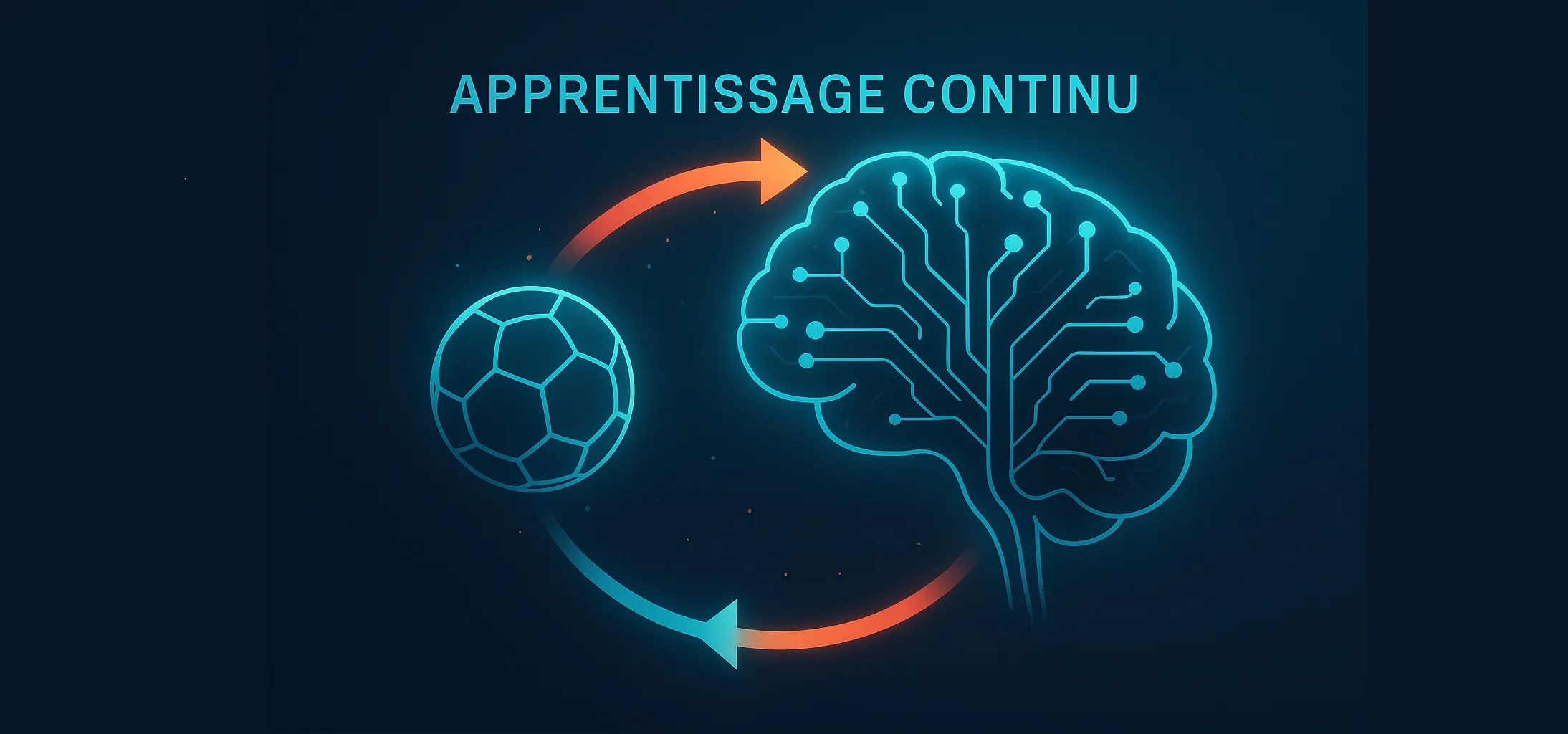
Framework (simple)
In football, teams change quickly (coaches, transfers, injuries, schedule). A model that was “good yesterday” can become less reliable tomorrow. Continuous learning does not mean “guessing the future”, but maintaining honest probabilities while adapting to change—without ever using future information.
One-sentence summary
Foresportia updates its predictions rigorously: new data → checks → after-the-fact evaluation → drift detection → league-level recalibration → automatic adjustments (thresholds/weights) with safeguards.
3 definitions (to stay oriented)
- Model drift: the league changes, so yesterday’s stats no longer fully describe today.
- Calibration: a “60%” should behave like ~6 cases out of 10 over a sufficiently long period.
- Auto-configuration: bounded automatic adjustments (small steps, no abrupt changes).
Why continuous learning is crucial in football
Football is a non-stationary system: squads evolve, playing styles shift, and some leagues are naturally more volatile. Without adaptation, a model can remain globally consistent while losing reliability in a specific league or period.
This is especially true at: season starts, congested schedules, transfer windows, or after coaching changes.
The pipeline (overview)
- Collection & checks: match data, consistency, timestamps.
- Pre-processing: aggregations, form indicators, schedule context.
- Prediction: raw probabilities + reliability indicators.
- Temporal validation: evaluation always on later matches, never on the future (data leakage prevention).
- League-level calibration: adjusting probability reliability on recent history.
- Auto-configuration: micro-adjustments (thresholds/weights) with limits and cooldowns.
- Monitoring: metrics and alerts (drift).
- Publication: export of results to the site.
Auto-calibration: probabilities that hold over time
Calibration is very concrete: if a model frequently announces ~60%, we want to observe ~60% corresponding outcomes over time.
This is measured using metrics (and especially reliability curves):
- Brier Score: penalizes probabilities far from reality.
- LogLoss: strongly penalizes overly confident errors.
- Reliability curve: compares announced probabilities to observed frequencies.
To go deeper (with a clear “60% = 6/10” example): Probability calibration.
Auto-configuration: adjusting usage without breaking reliability
Reliable probabilities are not enough: one must also decide how to use them (e.g., which matches to highlight). Auto-configuration adjusts operational parameters cautiously:
- League-specific thresholds: micro-adjustments based on the volume ↔ reliability trade-off.
- Temporal weighting: if drift appears, more weight is given to recent data (without overreaction).
- Regularization: with limited data (season start), extreme corrections are avoided.
- Safeguards: min/max bounds, limited speed, cooldown before further changes.
Complementary article: Thresholds: coverage vs accuracy.
Data leakage prevention: strict temporal validation
This is the most important point: a “continuously learning” system can become misleading if it indirectly sees the future. Here, evaluation uses chronological splits: training on the past, testing on the future.
Automatic adjustments (thresholds, weights) are applied only to upcoming matches, never by rewriting the past.
Concretely, what changes for you?
- More coherent probabilities: fewer “high percentages” that fail to hold over time.
- Better stability: fewer shocks when a league becomes temporarily chaotic.
- Clearer reading: uncertainty is better reflected instead of being hidden.
You can follow after-the-fact evaluation here: Past results.
FAQ
Does auto-configuration change every day?
No. Changes are bounded: small steps, min/max limits, and a delay before any new adjustment. The goal is stability, not agitation.
Why not apply a single global threshold?
Leagues do not share the same variance. A single threshold penalizes either volume or reliability. Hence the interest of a league-level approach.
Does calibration “guarantee” an outcome?
No. Calibration does not promise a certain match. It aims to make probabilities statistically more reliable, helping analysis without self-deception.
Conclusion
Continuous learning is not about “learning faster”, but about learning properly: temporal validation (data leakage prevention), drift monitoring, league-level recalibration, and cautious auto-configuration. The goal is simple: more reliable probabilities and clearer uncertainty.
Top match readings today
Continue with practical pages to read today's matches.
See today's match reading