Framework
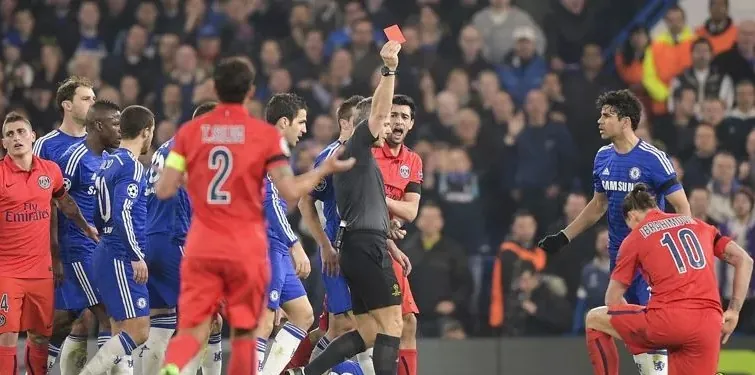
A red card is a rare event that can overturn a match, but it is not strictly predictable before kickoff. In data-driven analysis, the key challenge is to re-evaluate properly after it happens, without emotional or statistical overreaction.
Introduction: a spectacular event, but can it be predicted?
Playing 10 vs 11 changes pressing, transitions, defensive shape and chance creation. Yet adding a “red card probability” before the match is rarely useful: it usually injects more noise than signal.
Before kickoff: why predicting a red card is usually a bad idea
Before the match, a sending-off depends on a chain of micro-events: duels, timing, refereeing decisions, intensity and emotional context. Explicitly modeling this pre-match introduces uncertainty that is hard to calibrate.
- red cards are highly contextual (referee, minute, tension, player profile)
- their average effect is often already absorbed in historical results
- similar logic applies to penalties: global frequency is captured implicitly
👉 Conclusion: before kickoff, a red card is a random shock, better treated as background uncertainty than as an explicit variable.
During the match: a strong signal, but timing matters
After a red card, the key factor is not only “10 vs 11”, but how the team reorganizes tactically.
- Timing: early red = long exposure, late red = often limited impact
- Score: at 3–0 the effect may be small, at 0–0 it is often decisive
- Position: losing a striker is not the same as losing a centre-back
- Team profiles: deep-block outsider vs high-press favourite
- Psychology: short-term reaction exists but is unstable
How a prediction model handles red cards (without magic)
The goal is not to guess the final outcome, but to re-estimate dynamics after the event: rhythm changes, pressing drop, conceded chances.
- detection of rhythm breaks (intensity, dominance, chances)
- contextual integration (minute, score, position)
- league-level calibration (some leagues manage 10 vs 11 better)
- uncertainty index that may increase then stabilize
Related reading: Football upsets Hidden factors
Best practices when analyzing a red card
- avoid overreacting to the first minutes after the incident
- always contextualize (minute, score, position)
- focus on distributions and scenarios, not binary outcomes
- accept that rare events mechanically increase uncertainty
Conclusion
Before kickoff, a red card is too contextual to be modeled reliably. During the match, it becomes a major signal—provided timing and tactical adjustment are considered. A rigorous approach makes uncertainty visible rather than hiding it.
Quick FAQ
How should I read a probability on Foresportia?
A probability is an expected frequency, not a certainty for a single match.
Why does reliability matter?
Reliability shows how similar probabilities performed in historical data.
Does Foresportia promise an outcome?
No. The website provides probabilistic match reading and context, without guaranteed results.
Top match readings today
Continue with practical pages to read today's matches.
See today's match reading