Context
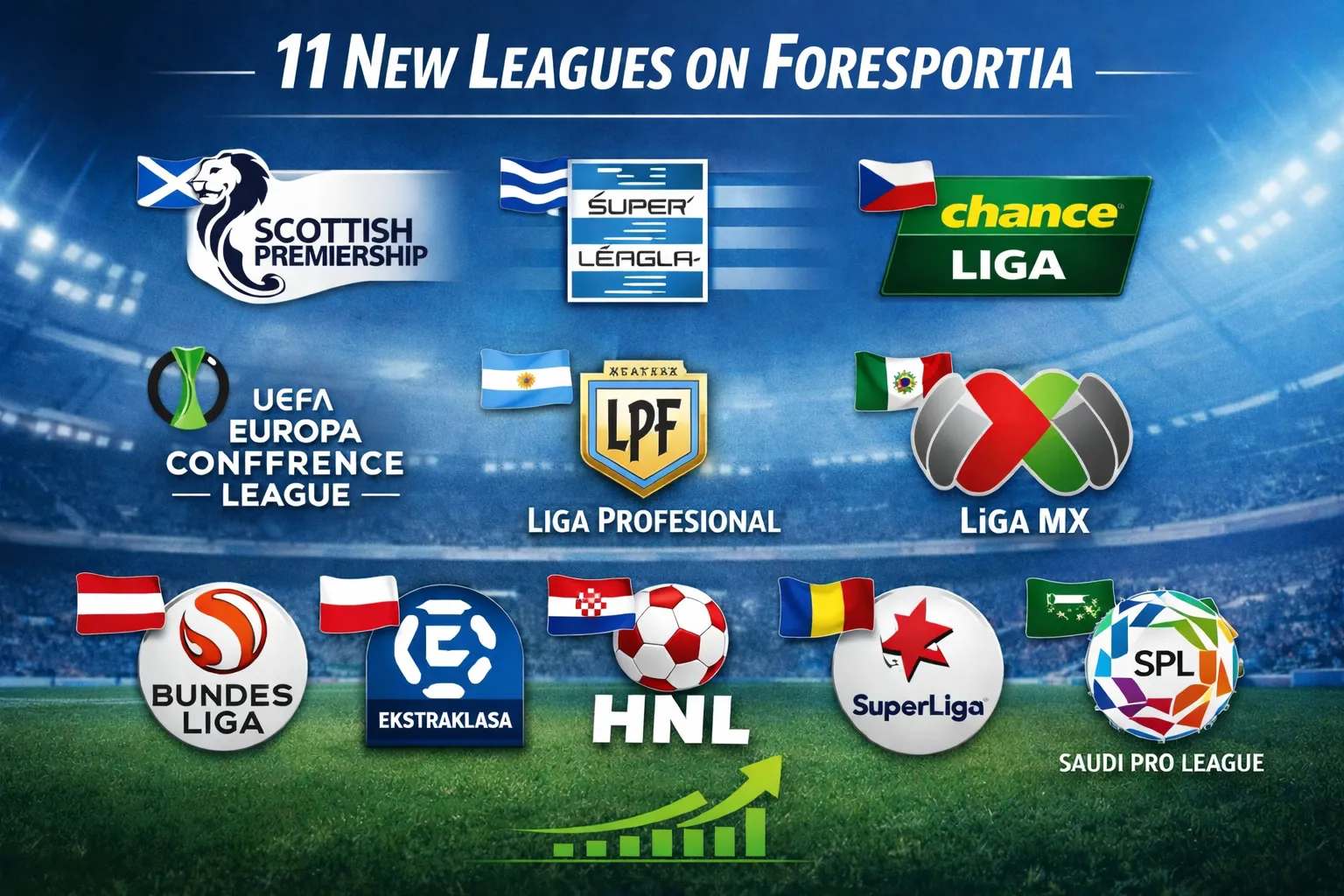
This update extends Foresportia coverage with 11 additional competitions. The purpose is not to overpromise outcomes, but to give users broader match context, more fixtures to compare, and smoother cross-league navigation in daily workflows.
Introduction
A useful football analysis platform should not stop at the same handful of overexposed leagues. Many users want to track competitions from their own region, follow different seasonal rhythms, or compare match profiles across leagues that are usually underrepresented in mainstream coverage.
In 2026, Foresportia expands in that direction with 11 new leagues. This is a product-level improvement, not just an announcement: users can now move across a wider set of competitions while keeping the same reading framework for probabilities, match context and historical validation.
If you are new to the ecosystem, the easiest starting path is: league hub, then today's match view, then historical results.
The 11 new leagues now covered by Foresportia
Below is the full list of newly covered competitions, with practical context for each one and direct links to existing league routes.
Scottish Premiership
A high-intensity domestic league with clear contrasts between top-end and mid-table profiles. It is useful for users who want to compare dominant scenarios against tighter game states across a full season. Open Scottish Premiership
Super League Greece
Often tactically dense and context-heavy, this competition is relevant for users who prioritize match structure and game-state discipline over purely headline-driven coverage. Open Super League Greece
Chance Liga
Chance Liga adds a strong Central European profile with a mix of open fixtures and tightly contested matchups. It is a good bridge for users expanding beyond top-five leagues while keeping readable competition dynamics. Open Chance Liga
UEFA Conference League
The Conference League delivers cross-country club matchups that rarely appear in mainstream weekly discussion. That variety makes it particularly useful for users who enjoy broader European fixture exploration. Open UEFA Conference League
Liga Profesional Argentina
A competition known for intense tactical and emotional contexts, where match framing can shift quickly from one round to the next. Its addition strengthens coverage for users already following South American football. Open Liga Profesional Argentina
Liga MX
Liga MX broadens Americas coverage with seasonal and scheduling patterns that differ from most European domestic leagues. It helps users build a wider weekly slate across time zones. Open Liga MX
Austrian Bundesliga
A competition with frequent tactical transitions and identifiable team profiles over the course of the season. It fits users looking for high-quality secondary European league coverage. Open Austrian Bundesliga
Ekstraklasa
Ekstraklasa brings a competitive domestic environment where league hierarchy can be volatile over short periods. This is useful for users who compare variance patterns across European competitions. Open Ekstraklasa
HNL Croatia
HNL Croatia adds another route into emerging-league analysis, with context-sensitive fixtures and evolving club trajectories. It complements users who already explore mid-tier European leagues. Open HNL Croatia
SuperLiga Romania
SuperLiga Romania strengthens Eastern European coverage and adds another pool of league-specific match context to compare within the platform. Open SuperLiga Romania
Saudi Pro League
Now an important reference point for a global audience, the Saudi Pro League expands coverage into a competition with growing visibility and distinct match profiles. Open Saudi Pro League
Why these competitions are worth following
This update is not only about adding more competitions on paper. It improves the way users can understand football diversity across regions, styles, and calendar structures.
- Broader football context: users can compare more than just the usual high-visibility leagues.
- More weekly match volume: useful for users who review fixtures multiple days per week.
- Cross-league benchmarking: league dynamics and variance become easier to compare.
- Less mainstream dependency: users can follow region-specific competitions without leaving the same workflow.
If you want deeper methodological context, these existing EN reads are good companions: league reliability, league variance, and cross-season league context.
What this changes on Foresportia
For users, the impact is practical and immediate. You can now navigate more competitions through the same core pages and keep one consistent reading routine.
- More competitions available on AI predictions by league.
- More dedicated league routes inside AI prediction results by league.
- Broader fixture availability on results by date and Top AI picks.
- Expanded historical comparison in past results.
- Wider context support in league statistics and team form insights.
In short, this is integrated into core product navigation, not a standalone editorial note.
How to explore these leagues on Foresportia
- Start from Predictions to browse competitions by region and league.
- Jump into Result pages for league-specific fixture reading.
- Switch to Results by date when you want a cross-league daily board.
- Validate historical behavior through Past results.
If you prefer team-first discovery, you can also start from team pages and move back to league routes from there.
Which leagues to follow first depending on your profile
If you mainly track European club football
Start with UEFA Conference League, Scottish Premiership, Austrian Bundesliga and Ekstraklasa. This gives you a broad European mix without relying exclusively on top-five domestic leagues.
If you want broader weekly coverage across time zones
Prioritize Liga Profesional Argentina, Liga MX and Saudi Pro League. These leagues help extend your viewing and analysis window beyond standard European kickoff clusters.
If you like tactical variation and league-specific context
Super League Greece, Chance Liga, HNL Croatia and SuperLiga Romania offer strong contextual variety and useful comparison points for users who focus on structure and game-state diversity.
If you want a simple first workflow
Use a three-step routine: pick one league in Predictions, review today in Results by date, then verify on Past results. This is enough to build a consistent cross-league reading habit.
FAQ
Are these leagues live in the same interface as existing competitions?
Yes. They are integrated into the existing league navigation, so users can access them through the same predictions and results workflows.
Do I need to follow all 11 leagues?
Not at all. Start with two or three leagues that match your profile, then expand once you are comfortable comparing contexts.
What is the practical user benefit of this update?
More fixture diversity, broader football contexts, and better cross-league comparison without switching tools or navigation patterns.
Does adding more leagues mean stronger certainty?
No. Foresportia remains probability-based and history-backed. More coverage improves exploration, not certainty on individual matches.
Conclusion
Expanding to 11 new leagues is a meaningful step for Foresportia users who want broader football coverage without changing how they analyze matches.
The value is clear: more competitions, more contexts, and stronger exploration paths across results, daily views and historical verification. The underlying philosophy stays the same: transparent probabilities, practical navigation, and no promises of certainty.
Top reads today
Move from concepts to practical pages for daily match analysis.
View today's match reading