Core idea
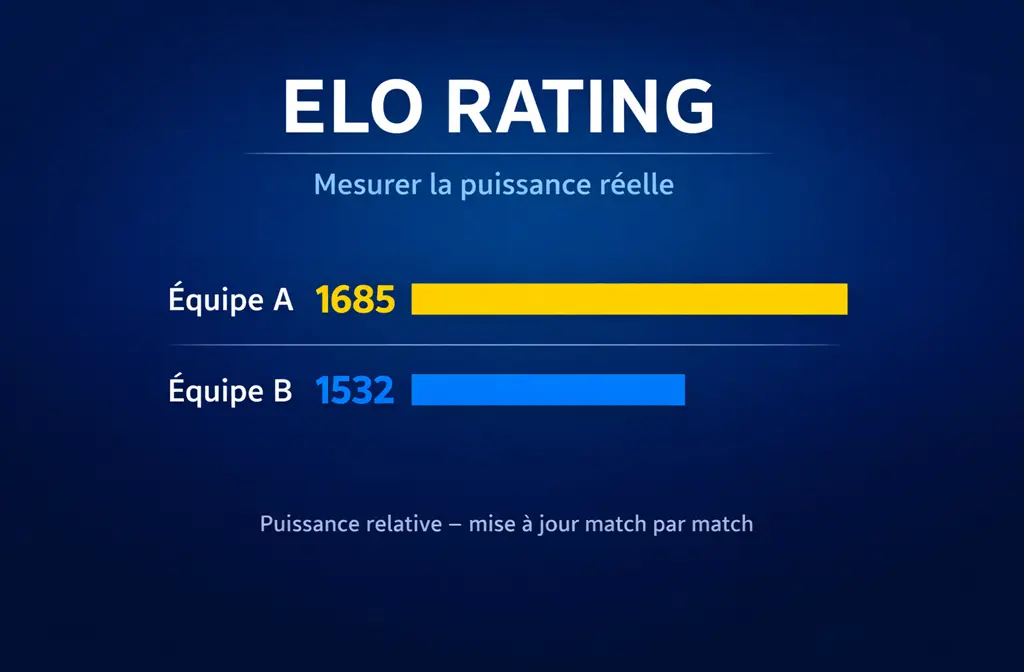
The league table shows points. Elo rating shows strength. At Foresportia, Elo is used to capture structural team power and refine how probabilities are interpreted — never to eliminate uncertainty.
Why league tables can mislead
Two teams can have identical points yet very different contexts: strength of schedule, recent opponent quality, match margins, or timing effects.
Raw standings accumulate outcomes. Elo measures how convincing and contextually strong those outcomes were.
How Elo rating works (simplified)
- Each team starts with a baseline rating.
- After each match, ratings adjust.
- Beating a strong team increases rating more.
- Losing to a weaker team decreases rating more.
- Home advantage can be incorporated as a structural parameter.
The result is a continuously updated strength hierarchy.
Why Elo matters for probability models
Probability models require contextual inputs. Elo provides a robust strength differential between teams, reducing overreaction to short streaks.
In practice, it:
- Stabilizes pre-match expectations
- Improves probability calibration
- Enhances confidence index interpretation
What Elo does NOT do
Elo is not a crystal ball. It does not predict injuries, weather shifts or tactical surprises.
It strengthens structural modeling — but football remains stochastic.
Conclusion
Elo rating helps quantify real team strength beyond the league table. Integrated carefully, it improves model robustness and probability readability.
But like every component in predictive analytics, it supports analysis — it does not create certainty.
Quick FAQ
How should I read a probability on Foresportia?
A probability is an expected frequency, not a certainty for a single match.
Why does reliability matter?
Reliability shows how similar probabilities performed in historical data.
Does Foresportia promise an outcome?
No. The website provides probabilistic match reading and context, without guaranteed results.
Top match readings today
Continue with practical pages to read today's matches.
See today's match reading