Framework
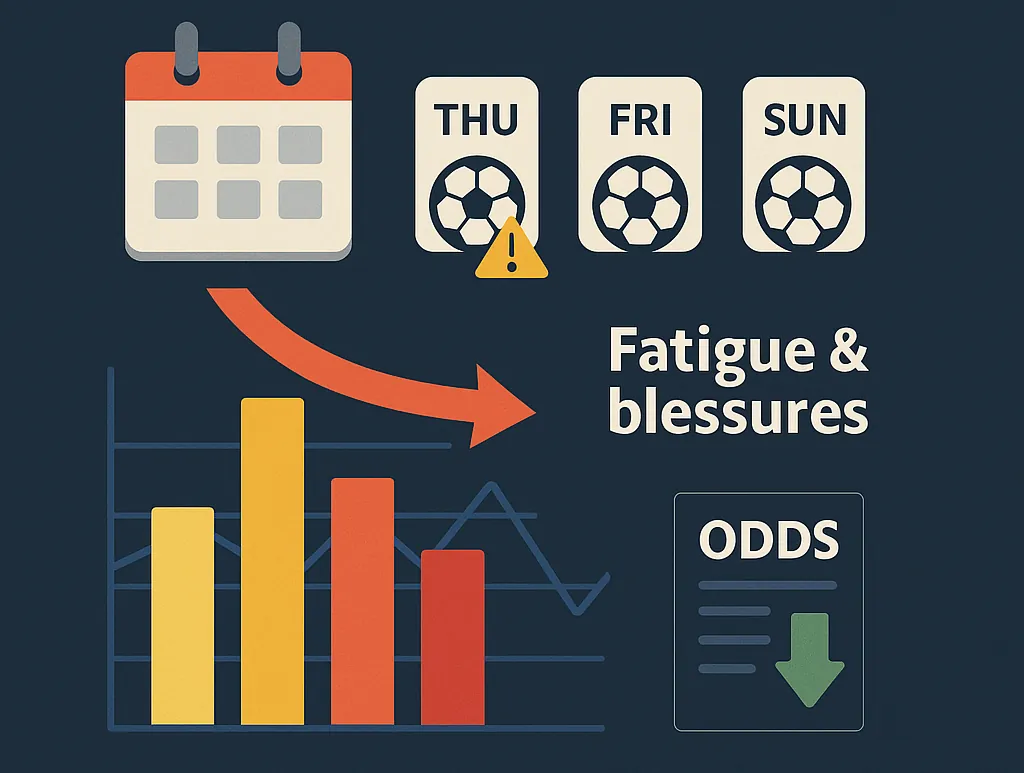
Schedule congestion is a major contextual factor. In data and AI terms, it acts as additional noise: lower average performance, more rotation, and higher unpredictability. Foresportia remains an analysis support tool: no promises, no guarantees.
Why schedule effects are a classic blind spot
Two matches that look identical on paper can be very different if one team is playing its third match in eight days, returning from long travel, or coming off extra time.
From a modeling perspective, ignoring schedule effects increases uncertainty and can degrade calibration.
Modern football calendars: congestion and recovery costs
Between league matches, domestic cups, European competitions, and international breaks, some clubs exceed 50–60 matches per season.
- Reduced recovery: fewer rest days lower intensity and clarity.
- Increased rotation: unstable lineups raise tactical variance.
- Injury risk: late absences create mismatches between data and reality.
How fatigue appears in observable data
- lower xG and shot volume or quality,
- reduced pressing efficiency,
- more defensive errors,
- late concessions,
- unusual lineup turnover.
These effects vary by squad depth, travel, and match intensity.
Why the impact differs across leagues
- England: dense winter periods with heavy rotation.
- European competitions: rest asymmetries after midweek matches.
- Long-distance travel: preparation and recovery disruption.
Rather than generalizing, data-driven approaches treat these as contextual variables that increase deviation risk from average performance.
How AI-based models integrate schedule effects
The goal is not to arbitrarily adjust probabilities, but to represent context realistically.
Basic variables
- rest days since last match
- matches played over the last 10–14 days
- travel distance or time (proxy)
Advanced variables
- minutes played by regular starters (when available)
- lineup stability / rotation index
- competition load indicators
In a responsible framework, schedule effects should primarily lower the confidence index when instability rises, rather than force a scenario.
Practical checklist: spotting schedule-related risk
- very short recovery windows (≤ 3–4 days)
- consecutive travel-heavy matches
- heavy or uncertain rotation
- clusters of injuries
- sandwich matches around major fixtures
Conclusion: schedule effects call for caution, not shortcuts
Schedule congestion increases uncertainty through fatigue, rotation, injuries, and cohesion loss. A robust analysis framework makes this risk visible and reflects it in reliability indicators, rather than hiding it.
Quick FAQ
How should I read a probability on Foresportia?
A probability is an expected frequency, not a certainty for a single match.
Why does reliability matter?
Reliability shows how similar probabilities performed in historical data.
Does Foresportia promise an outcome?
No. The website provides probabilistic match reading and context, without guaranteed results.
Top match readings today
Continue with practical pages to read today's matches.
See today's match reading