Why most people misunderstand "60%"
Seeing "60% chance of winning" often gives the impression that the outcome is almost certain. In reality, it simply means: in comparable matches, this scenario occurs about 6 times out of 10. And therefore, 4 times out of 10, it does not.
The most common mistake is confusing probability (a distribution of scenarios) with certainty (a future fact).
Simple definition: what does a win probability mean?
A "Team A win = 60%" probability is a statistical estimate built from data: team strength, recent form, context, historical performance, and other measurable signals.
- It does not remove randomness: one incident can change everything.
- It does not say what will happen, but what is most plausible.
- It depends on context (absences, schedule, travel).
The real question is not "will this 60% win tonight?", but "what settled 1X2 dataset supports this number, how large is the sample, and how stable is the league around it?". That is the difference between reading a number and reading a probability.
Variance: why football remains unstable
Football is a low-scoring sport, which leads to high relative variance. A single event can strongly shift the distribution of outcomes.
That is why a "60% match" can still be highly uncertain, especially when the draw probability is high or the context is unusual.
The same logic explains why even a 70% favorite can fail without invalidating the model. A probability band is a repeated-behavior statement, not a single-game guarantee. If you judge the model only on one upset, you are testing your emotions, not the probability itself.
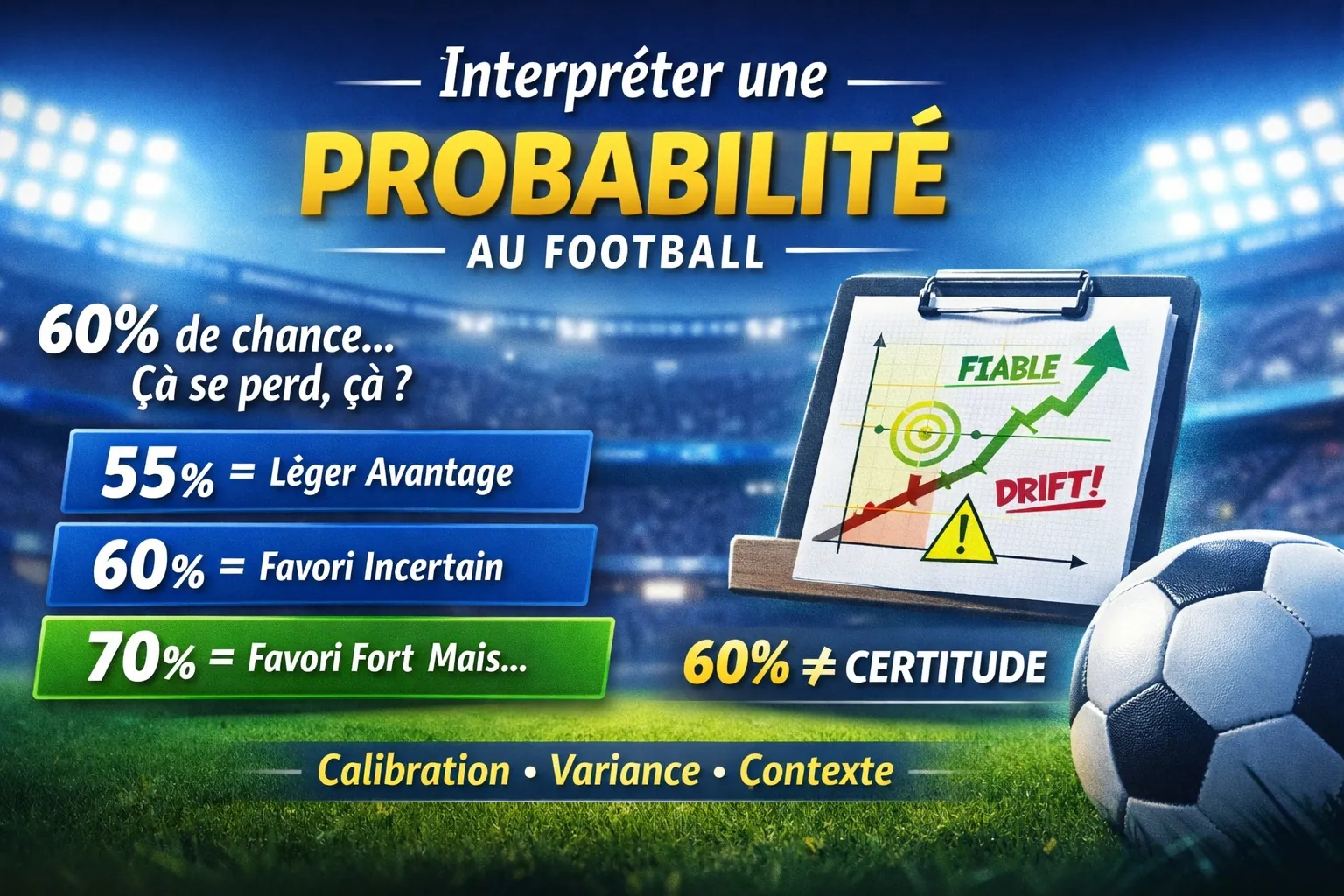
55%, 60%, 70%: practical differences
- 55%: slight edge -> very open match.
- 60%: clear favorite -> surprise remains frequent.
- 70%: strong favorite -> uncertainty still exists.
A higher probability is not automatically more reliable: calibration at league level matters.
In plain language, a 55% signal usually means a slight edge, a 60% signal starts to define a clearer favorite, and a 70% signal is historically strong without ever becoming a guarantee. The number grows, but uncertainty never disappears.
Real example: what Foresportia data actually shows
Across 12,133 settled 1X2 matches, favorite scenarios land 67.9% of the time in the 55-59% zone on 984 matches, 73.9% in the 60-64% zone on 685 matches, and 88.0% above 70% on 719 matches.
Sample size matters as much as the percentage itself. The 70%+ band is strong, but it still contains 86 misses in the current settled sample, which is exactly why one favorite can fail without invalidating the model.
Recent examples make the point clearer. Flamengo vs Cruzeiro was priced at 56.95% for Flamengo and finished 2-0. But Mirassol vs Santos was read at 56.33% for Mirassol and ended 2-2. Even Manchester City vs Nottingham Forest at 71.91% still finished 2-2.
Calibration: the ultimate reliability test
A probability only has value if it is calibrated. A calibrated 60% means: over many similar matches, about 60% actually occur.
This is why the page keeps linking back to calibration instead of pretending that one number is self-explanatory. Interpretation starts with the percentage, but credibility comes from the dataset behind that percentage: settled 1X2 history, enough sample size, and a league context that has been checked rather than assumed.
Five common mistakes
- Assuming a favorite scenario will happen.
- Ignoring the draw probability.
- Comparing leagues without calibration.
- Forgetting match context.
- Over-interpreting exact scores.
The most common reader error is emotional, not mathematical. One upset feels like proof that the number was wrong, but a probability should be judged on repeated behavior inside the relevant dataset, not on the frustration created by one surprising result.
Case reading: two matches, same 60%, different meaning
Match A and Match B can both display 60% home-win probability, yet carry different practical risk.
- More stable recent sample: in the current 60-64% band, Ligue 1 reaches 83.0% correct scenarios on 47 matches.
- More fragile recent sample: Portugal sits at 62.5% on 32 matches in the same band.
- Higher but still limited sample: the Championship reaches 90.9% on 44 matches.
Volumes are still moderate, so this is not a fixed ranking. The useful lesson is simpler: the number alone is never enough. You must combine probability with league stability and context intensity.
That is also why the dataset label matters. Here we are talking about a settled 1X2 match base, not about BTTS, over/under or pick profitability. Using the wrong dataset would completely change the meaning of the same percentage.
Mini method: how to use a 60% signal in practice
- Check whether similar 60% bins were calibrated on historical data.
- Read the competing scenarios (draw/away) instead of only the favorite side.
- Review context stressors: absences, travel, fixture congestion.
- Downgrade confidence when several instability flags accumulate.
A strong reading is not "60% therefore done." It is "60% with this uncertainty profile and this context load."
Practical next step: start on results_by_date, then cross-check the logic with past results, calibration and methodology.
This is what keeps the article practical instead of academic. The goal is not to teach probability theory in the abstract. It is to help a reader answer a concrete question on a match page: should I treat this percentage as a stable edge, a medium signal, or a number that needs extra caution?
If the sample is thin, the league unstable, and the draw structure awkward, a 60% should be read as a medium signal. If the league history is cleaner and the confidence context stronger, the same 60% becomes more actionable. That is exactly why interpretation deserves its own page instead of a dictionary-style definition.
Conclusion: 60% is useful if read correctly
A probability is a compass, not a crystal ball. Its value lies in understanding plausible scenarios, uncertainty, and the reasons behind the numbers.
Better interpretation always beats stronger certainty language.
The most useful habit is simple: read the percentage, check the competing outcomes, and then ask what the underlying 1X2 history says about similar cases. That is how a number becomes a decision aid instead of a headline.
Once that habit is in place, a 60% stops sounding vague and starts becoming a practical reading signal.
That is the entire point of this guide: turning a common percentage into a clearer match-reading reflex.
It keeps the discussion simple, but not simplistic.
Quick FAQ
How should I read a probability on Foresportia?
A probability is an expected frequency, not a certainty for a single match.
Why does reliability matter?
Reliability shows how similar probabilities performed in historical data.
Does Foresportia promise an outcome?
No. The website provides probabilistic match reading and context, without guaranteed results.
Where can I continue after this guide?
Browse the blog hub for related pages on calibration, reliability, and match-context interpretation.
Top match readings today
Continue with practical pages to read today's matches.
See today's match reading