Context
This article introduces a major upgrade to Foresportia’s statistical modelling layer. It is not a full redesign, but a significant reinforcement of an already established framework including score grid modelling, Dixon-Coles corrections, calibration layers and league-specific parameter tuning.
Alongside this, Foresportia continues to evolve its AI / Machine Learning challenger model, a calibrated overlay already deployed to monitor performance and correct residual bias.
Goal: produce probabilities that are more reliable, stable and auditable. A probability is never a guarantee — only a calibrated estimate of uncertainty.
Why Improve the Statistical Engine Instead of Rebuilding Everything?
Foresportia has always been based on one core principle: football is uncertain, but not purely random.
The foundation of the prediction engine is a score probability grid P(i,j) representing home and away goal distributions. From this grid, all major football betting-style markets are derived consistently: match result probabilities, over/under goals, BTTS, clean sheets and more.
Historically, this grid relies on the Poisson model enhanced with well-known corrections such as Dixon–Coles. While robust and interpretable, empirical football data often shows a key limitation:
Poisson assumes variance equals the mean.
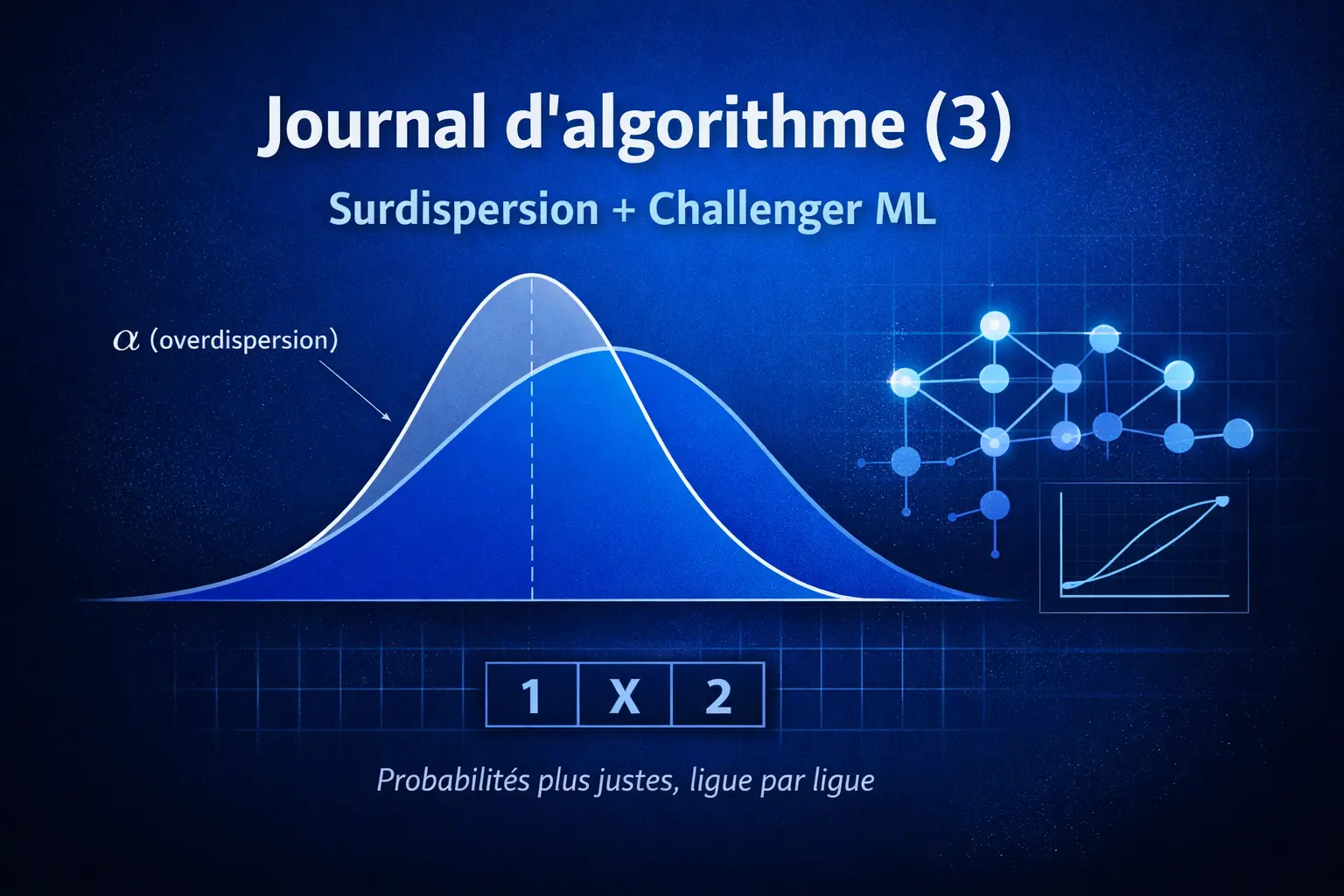
In many leagues and match contexts, real-world score variability is higher. This phenomenon is called overdispersion.
The goal of this upgrade is therefore not replacement — but controlled flexibility where data demonstrates Poisson becomes too restrictive.
Improvement #1 — Overdispersion Modelling Using Negative Binomial Distribution
To better represent matches where score variability exceeds Poisson assumptions, Foresportia introduces a Poisson-Gamma formulation equivalent to a Negative Binomial distribution.
The Key Parameter: α (alpha)
Variance becomes: Var = λ + λ² / α
Higher α approaches Poisson behaviour, while lower α allows higher score variability.
Activation Logic
- Poisson remains the default baseline model
- Negative Binomial activates only when historical data confirms overdispersion
- League-specific α is estimated with safeguards and fallbacks
Expected impact: Improved probability distribution across plausible score outcomes and reduced overconfidence in volatile leagues.
Improvement #2 — League-Specific Parameters and Bayesian Stabilisation
Football leagues behave differently. However, aggressive parameter fitting on small samples leads to overfitting.
Foresportia now reinforces parameter robustness through Bayesian shrinkage and safeguarded estimation.
Improved Parameters
- Overdispersion α per league
- Dixon-Coles correlation Ï with season-start damping
- Home Field Advantage shrinkage and progression
- League draw calibration factors
- Temperature / entropy adjustments
Bayesian priors ensure stability when historical data is limited — preventing noisy estimates.
Improvement #3 — Score Grid as the Single Source of Truth
Once P(i,j) is estimated, most prediction markets are derived directly from this distribution.
This architecture ensures internal coherence and improves auditability.
Markets Derived from Score Grid
- BTTS probability
- Over / Under goal markets
- Clean sheets & win-to-nil
- Winning margin probabilities
- Double chance & Draw-No-Bet
- Entropy metrics and expected goals estimation
Will These Improvements Change Displayed Probabilities?
Potentially, yes — and that is intentional.
Better modelling redistributes probability mass more realistically across outcomes.
The objective is calibration: If Foresportia predicts 60%, historically similar matches should win approximately 60% of the time.
The AI / Machine Learning Challenger Model
The statistical model remains the interpretable core. The ML challenger acts as a performance correction overlay.
Champion-Challenger Framework
- Blended predictions combining baseline and ML outputs
- Context-specific corrections where ML demonstrates measurable improvement
- Adaptive weighting if baseline underperformance is detected
Calibration is Mandatory
Machine learning outputs are calibrated using techniques such as Platt scaling to ensure outputs remain true probabilities.
Strict Temporal Validation
Training uses historical data, hyperparameters are selected on validation windows, and final evaluation occurs on unseen future data.
Performance monitoring prioritises: LogLoss and Brier Score.
Monitoring and Continuous Validation
- LogLoss for probability accuracy
- Brier score tracking
- Calibration curve monitoring
- League-specific performance tracking
- Temporal drift detection
Summary
- League-level overdispersion modelling
- Strengthened league parameter estimation
- Bayesian shrinkage for stability
- Score grid as universal probabilistic backbone
- Calibrated AI challenger overlay
- Metric-driven optimisation
The result is a prediction engine designed for long-term probabilistic reliability rather than short-term confidence inflation.
Top match readings today
Continue with practical pages to read today's matches.
See today's match reading